
The Ecosystem Perpetuity Fund Feasibility Study: Mobilizing Private Capital for High-Impact Conservation
Written by Andrew Boughner (agb2206)
Advised by Satyajit Bose
Canada is facing an urgent ecological crisis, with ecosystem degradation accelerating across several critical landscapes. From wetlands to temperate forests, development pressures, climate change, and habitat loss are outpacing current protection efforts, underscoring the need for conservation. This report presents a novel and data-driven approach for the Ecosystem Property Fund, a privately financed, non-profit initiative designed to acquire and protect high-value ecosystems in perpetuity.
At its core, the study’s objective was to identify which Canadian biome offers the greatest conservation impact per dollar invested, accounting for ecological value, development threat, and climate resilience. Through a risk assessment balanced scoring model, coastal wetlands in Eastern Canada emerged as the most strategy starting point for fund deployment. These ecosystems offer strong biodiversity value, cost-effective land prices, and a relatively low risk of natural disaster exposure compared to other biomes.
With the target biome identified, the Ecosystem Perpetuity Fund is now positioned for mobilization. Key priorities for activation include:
[1] Finalize Fund Structure: Establish the nonprofit entity, secure charitable status, and assemble a qualified Board of Directors and Executive Director to oversee governance and execution.
[2] Capital Mobilization: Launch targeted outreach to high-net worth individuals, impact investors, and ESG-aligned corporations to seed the endowment and cover initial land acquisition costs
[3] Land Diligence and Acquisition: Identify and evaluate coastal wetland parcels in Nova Scotia, Newfoundland, and Prince Edward Island for investment
[4] Operational Readiness: Build a conservative financial model, define long-term operating needs, and establish a university partnership to support monitoring, reporting, and ongoing land stewardship
Overall, the Ecosystem Perpetuity Fund offers an innovative model for mobilizing private capital toward the permanent protection of Canada’s most valuable ecosystems. It combines financial discipline, ecological science, and long-term stewardship, creating a replicable and enduring solution to the country’s conservation challenge. Given Canadian ecosystems need for immediate conservation, this study offers a powerful blueprint to protect nature not just for today, but for generations to come.
1.1 Background and Context – Ecosystem Degradation in Canada
Canada is facing an urgent ecological crisis, with ecosystem degradation accelerating across its most critical landscapes. From wetlands to temperate forests, development pressures, climate change, and habitat loss are outpacing current protection efforts, underscoring the need for conservation. At the same time, there is no clear consensus on which biome should be prioritized for protection, particularly when considering factors such as potential financial return on investment (ROI), vulnerability to natural disasters, and the threat of future development. This study aims to identify the Canadian biome that should be prioritized for long-term protection and outlines the necessary steps for a novel approach to ensure its preservation in perpetuity.
1.2 Objectives Of Study
The overall objective of this study is to evaluate which biome would be most suitable for protection if an Ecosystem Perpetuity Fund were established in Canada, and to explore the necessary steps required to achieve long-term conservation of an ecologically significant landscape.
The Guiding Objectives for this study include:
Objective 1: Develop a model that demonstrates the most lucrative biome to invest in, taking into consideration Ecological Value ROI, Natural Disaster Threats to Biome, and Threats to Biome (from development activities).
Objective 2: Outline the necessary steps required to move from a feasibility assessment to mobilization through the establishment of the Ecosystem Perpetuity Fund.
1.3 Guiding Research Questions
The study has been guided by understanding which biome in Canada should be prioritized for protection based on ecological significance, urgency of threat, and potential for long-term conservation impact. To identify this, the following research questions have been posed:
Question 1: How can the ecological and economic value of different ecosystems in Canada be quantified in financial terms?
Question 2: Which ecosystem biomes in Canada offer the highest conservation impact per dollar invested, from a conservation perspective, normalized by the per-acre cost of land acquisition?
Question 3: How can the risk of future development threats be integrated into the biome selection process?
Question 4: How can the risk of natural disasters be factored into the evaluation and prioritization of the biome selection process?
Question 5: What steps would be required to move from the ideation phase to the actual implementation of the Ecosystem Perpetuity Fund?
2 | Biome Risk Assessment Balanced Score Analysis and Methodology
2.1 Section Abstract
This section presents a comprehensive, data-driven framework to assess the ecological and financial investment potential of Canada’s major biomes. Through the development of a robust financial model, the analysis integrates three key inputs: Biome Adjusted ROI per Acre, Risk of Extreme Events, and Threat Score into a single, weighted composite score for each biome. These scores are designed to guide investors, policymakers, and conservation practitioner in making evidence-based decisions surrounding the prioritization of land protection and ecosystem preservation in Canada.
This model reveals that coastal wetlands represent the most promising biome for conservation investment. These ecosystems combine exceptionally high ecological service value with moderate land costs, strong climate resilience, and increasing urgency for protection. Inland wetlands rank second due to their significant carbon storage, water regulation functions, and biodiversity benefits. Coastal systems follow closely, offering high biological productivity and climate mitigation potential, but with greater exposure to environmental pressures.
In addition to biome-specific insights, this section offers detailed methodologies for calculating ecosystem service values, estimating land costs across Canada, assessing climate risk exposures, and evaluating development threats. It also includes a breakdown of the indicators and scoring systems used to generate each metric, ensuring transparency and replicability.
The findings and rankings presented in this section are underpinned by a dynamic financial model that allows users to adjust assumptions based on their specific goals, whether emphasizing financial return, climate resilience, or conservation urgency. For further information, refer to the financial model that accompanies this study for a full breakdown of assumptions, scoring inputs and sensitivity analysis capabilities.
In summary, this model offers a scalable and adaptable tool to guide impact-driven investment strategies in Canada’s natural ecosystems, balancing ecological value, environmental risk, and long-term resilience.
2.2 Model Overview and Objectives
This section introduces a structured financial model developed to evaluate and prioritize Canada’s biomes for conservation-oriented investment. The model produces a Risk Assessment Balanced Score that reflects the relative attractiveness of each biome, taking into account both ecological value and risk considerations.
At its core, the model is designed to support a scored ranking system for biomes based on three key inputs:
[1] Biome Adjusted ROI per Acre: A measure of the ecosystem service value generated per unit of land cost, reflecting financial efficiency.
[2] Risk of Extreme Events: A resilience score that accounts for the biome’s exposure to climate-related hazards such as flooding, wildfire, and sea level rise.
[3] Threat Score: An assessment of development pressure, land-use conversion risk, and overall ecosystem vulnerability.
These inputs are combined using a weighted average formula (80% ROI, 10% Risk, 10% Threat), enabling the model to identify which biomes offer the highest ecological return on investment while also considering conservation urgency and long-term stability.
The objective of the model is to provide investors, policymakers, and conservation stakeholders with a transparent, evidence-based tool for determining where to focus ecosystem preservation efforts in Canada. By balancing return potential with environmental risk and land-use pressure, the model enables strategic, impact-driven investment decisions that maximize both financial and ecological outcomes.
2.3 Overview Of Biomes Assessed in Analysis
Canada’s diverse landscapes support a vast array of ecosystems, each playing a crucial role in maintaining biodiversity, regulating climate, and sustaining economic and cultural activities. From the rugged coastlines of the Atlantic and Pacific to the expansive freshwater systems, temperate forests, and open grasslands of the interior, these biomes provide essential ecological services and habitats for countless species. Inland and coastal wetlands act as natural buffers, filtering water and mitigating flood risk, while woodlands and boreal transition zones store carbon and support wildlife uniquely adapted to harsh conditions. These ecosystems are deeply interconnected, shaping not only the country’s natural heritage but also the livelihoods of those who depend on them. However, as human activity and environmental pressures continue to reshape these landscapes, the need for sustainable management and conservation has become increasingly evident. For more details regarding the biomes assessed in this analysis, refer to the Appendix Section labelled “4.1 Overview of Biomes Assessed in Analysis”.
2.4 Overview of Category 1 Biome Adjusted ROI:
Biome Value Per Acre Methodology
To assess ecological value of each biome, this analysis leverages the De Groot’s report “Estimates of the Value of Ecosystems and Their Services in Monetary Units”. The methodology used in the report provides a standardized approach for assigning monetary values to ecosystem services across the different biomes found in Canada and includes studies that had sufficient detail to calculate per-hectare values while clearly outlining the valuation methods and inputs. This ensures consistency and comparability across biomes
To standardize values, the De Groot report converts all monetary estimates into 2007 International dollars per hectare per year (Int$/ha/year). This standardization involves multiple steps, including adjusting for inflation using GDP deflators from each country and converting values into a common currency using Purchasing Power Parity (PPP) conversion factors from the World Bank. This process ensures that values are comparable despite variations in reporting currency, periods, and economic conditions across different regions.
A range of monetary valuation approaches is employed to derive these estimates in the De Groot Report. The study incorporates market-based methods, such as direct market pricing of goods and services, alongside cost-based approaches that estimate value through avoided costs, mitigation costs, and replacement costs. Additionally, it utilizes revealed preference methods, including hedonic pricing and travel cost analysis, as well as stated preference methods, such as contingent valuation and group valuation. In some cases, production function approaches are used to estimate the value of ecosystem services based on their contribution to economic production. By integrating multiple valuation techniques, the study captures the diverse ways in which ecosystem services generate economic benefits.
Once the monetary values are established, the report aggregates ecosystem service values across different categories for each biome. The mean value per hectare is calculated for each service, and these values are aggregated to estimate the total per-hectare value of the biome’s ecosystem services on a sustainable basis. The methodology accounts for variations in reported values by analyzing standard deviations, medians, and ranges. It also considers the geographic and socio-economic context of the studies, ensuring that differences in land use, population density, and ecosystem characteristics are factored into the valuation.
To address variability and limitations, the methodology includes adjustments to account for differences in study locations, valuation methods, and potential double-counting when aggregating multiple services. The report acknowledges that ecosystem service values can vary significantly based on local conditions and that applying generalized values across large geographic areas requires caution. Despite these limitations, the standardized methodology provides a robust framework for estimating the economic value of ecosystem services across biomes, offering a useful tool for conservation planning, policy development, and sustainable land management.
The Ecosystem Investment Prioritization Model (EIPM) Model directly leverages the per-hectare values for each biome, the refines these estimates by converting them into a per-acre basis to ensure consistency in reporting and facilitate comparisons across different land management and policy contexts. This conversion allows for easier integration with land valuation practices that commonly use acres as the standard metric. Additionally, recognizing that the original values were calculated using data from 2007, the study adjusts all figures for inflation to reflect more current economic conditions. By applying inflation adjustments using GDP deflators, the methodology ensures that the estimated ecosystem service values remain relevant and applicable to contemporary decision-making. Furthermore, given the study’s Canadian context, all values are converted from international dollars (Int$/ha/year) to Canadian dollars (CAD)to enhance clarity and applicability for local stakeholders. To account for the long-term benefits of ecosystem protection, the study also calculates the net present value (NPV) of ecosystem services over a 100-year time horizon. This approach recognizes that the value of ecosystem services extends far beyond a single year and ensures that assessments reflect the cumulative benefits of preserving these landscapes in perpetuity. These adjustments enhance the accuracy and usability of the data for this study.
Biome Average Cost Per Acre in Canada
The next step in calculating the biome value per acre was determining an average cost per acre of land across the biomes, which multi-step methodology that emphasized regional representativeness and data normalization. The process began by identifying the regions of Canada where each biome is most geographically concentrated. For example, the Boreal Forest biome was primarily examined in northern Ontario and Quebec, while the Tallgrass Prairie was evaluated as most ecologically concentrated within southeastern Manitoba.
Once these representative regions were identified, current vacant land listings were gathered from public real estate platforms. Only undeveloped or minimally developed parcels were selected to best reflect the baseline value of natural land in each biome. The listed property prices were normalized to a per acre value, allowing for consistent comparison across properties of different sizes. Multiple samples were collected in each region to ensure the data reflected a reasonable market average rather than relying on a single outlier listing.
Finally, for each biome, a weighted average of the per acre cost was calculated based on the proportional land area that each sampled region contributes to the overall biome in Canada. This weighting ensures that the final cost estimate reflects not only local market conditions, but also the relative ecological footprint of that region within the biome. This approach balances market-based data with ecological distribution to produce a fair and regionally informed estimate of average land cost per acre.
Adjusted ROI Calculation
Following the estimation of average land cost per acre by biome, a ROI analysis was conducted to assess the potential ecological value yielded per unit of financial investment. For each biome, the ROI was calculated as the ratio of the estimated ecosystem service value to the average price per acre. This provided a standardized measure of ecological return relative to the acquisition cost, helping to identify which biomes offer the most environmental value per dollar spent.
To allow for a consistent comparison and integration into a broader prioritization model, these raw ROI values were then normalized to a 1–10 scale. The highest ROI observed across all biomes was set as the benchmark (assigned a value of 10), and all other ROI scores were scaled proportionally using the formula:
Adjusted ROI Score = (Biome ROI / Max ROI) × 10.
This ensured that each biome’s performance was contextualized relative to the best-performing biome in terms of ecological return on investment.
The resulting Adjusted ROI Scores are then used as one of the core components within a broader composite biome assessment framework, alongside other inputs such as extreme event risk and threat scores. This approach provides a quantifiable and comparative foundation for evaluating the cost-effectiveness of ecosystem preservation across Canada’s diverse biomes.
2.5 Overview of Category 2 Risk of Extreme Events
To assess the vulnerability of each biome to climate-related and ecological hazards, a structured approach was developed to quantify the risk of extreme events across Canada’s major ecosystem types. This risk score is intended to inform prioritization frameworks by identifying biomes that may be more susceptible to climate disruptions, physical degradation, or natural disasters. For a definition of the Extreme Event Categories, refer to the Appendix section labelled “4.2 Category 2 Risk of Extreme Events – Defining Extreme Event Categories.”
Assigning Regional Exposure by Biome
For each biome, risk scores were assigned for the relevant event categories based on the geographic regions where the biome is most prevalent. Risk levels were scored using a qualitative three-point scale:
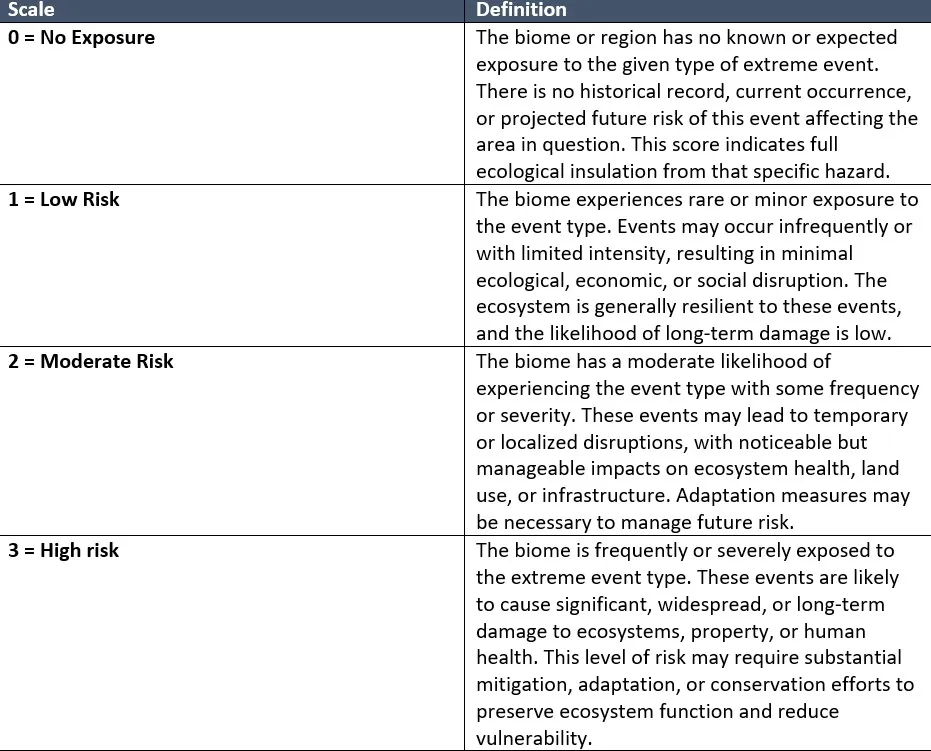
These scores reflect the likelihood of occurrence, historical frequency, and potential ecological impact of each event type within the context of that biome’s geographic distribution.
Calculating a Composite Extreme score
To generate a standardized resilience score for each biome, the individual extreme event risk scores were first totaled and then normalized to a 0–10 scale using the formula:
Normalized Risk Score = (Total Risk Score for Biome / Maximum Possible Risk Score) * 10
Where the maximum possible score is equal to the number of applicable extreme event types multiplied by 3 (the highest risk level per event). This provides a consistent way to compare biomes based on their overall exposure to climate-related hazards.
To align with the broader scoring framework, where higher values reflect more favorable conditions, the normalized risk score was then inverted to produce an Adjusted Extreme Risk Resilience Score. This final score reflects the relative resilience of each biome to extreme events, using the following transformation:
Adjusted Risk Resilience Score = 10 – Normalized Risk Score
In this format, a score of 10 indicates minimal exposure and high resilience, while a score closer to 0 indicates high vulnerability to extreme events. This approach ensures consistency across scoring metrics, enabling integration into a composite biome assessment model.
2.6 Overview of Category 3 Threat score
The Threat Score estimates the degree to which each biome in Canada is at risk of development or ecological degradation due to human activity. This score captures land-use pressures such as urban expansion, agricultural conversion, infrastructure development, and the absence of land protection. Biodiversity sensitivity is not included in this metric as it is addressed separately.
Indicator Framework
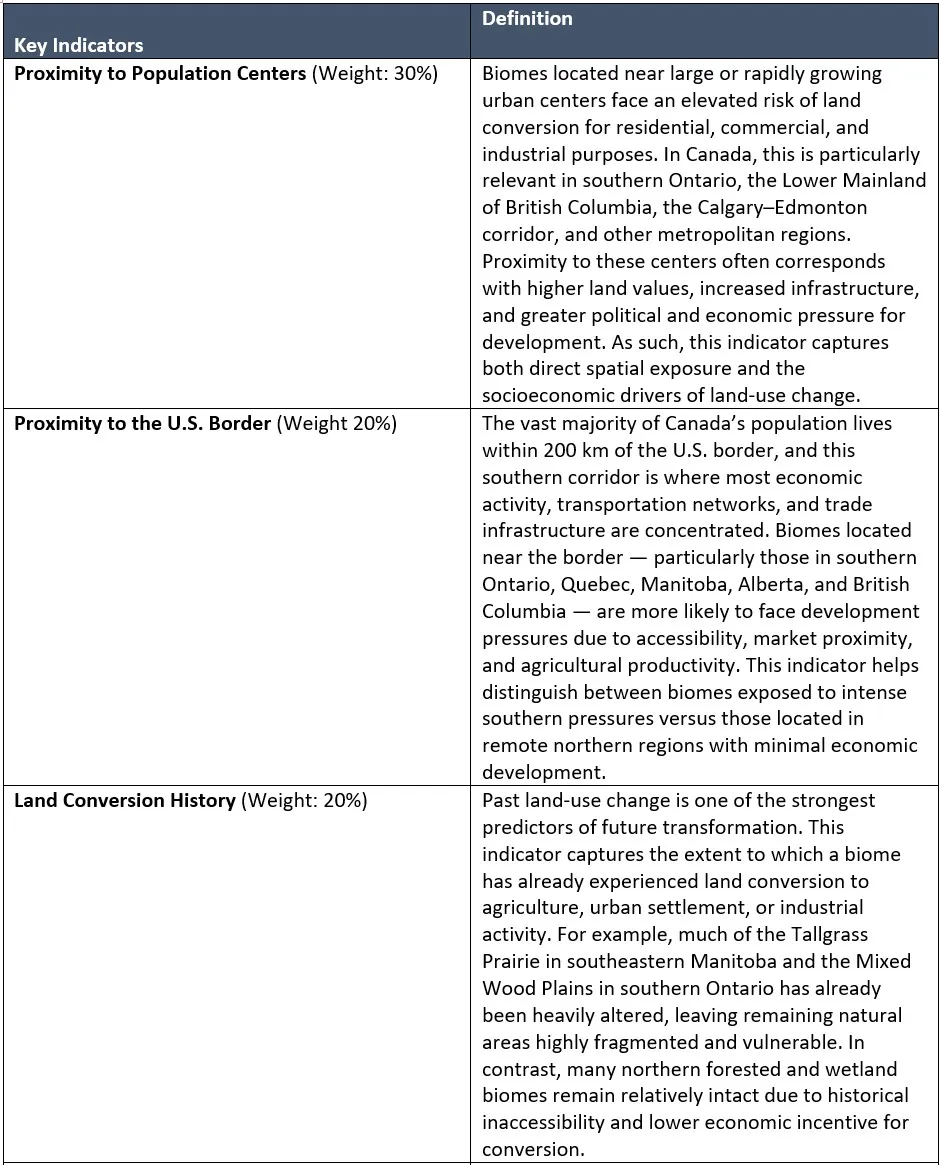
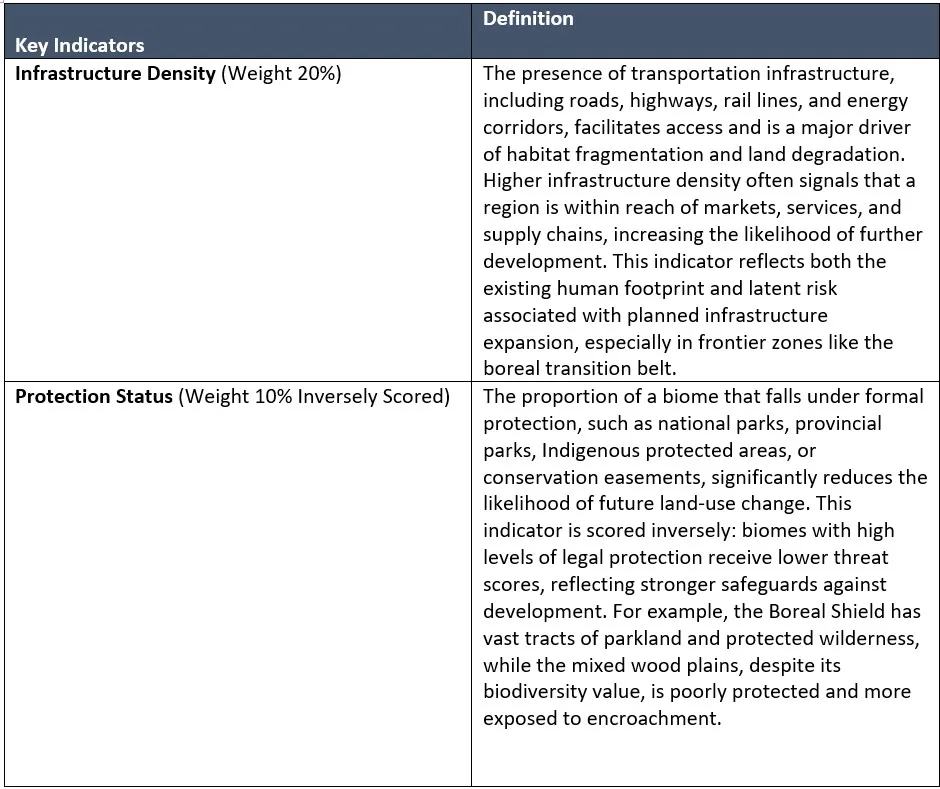
To evaluate the relative development threat across Canadian biomes, five key indicators were selected based on their influence on land conversion, habitat fragmentation, and long-term ecological degradation. These indicators were chosen for their relevance to Canada’s land-use dynamics and their alignment with national conservation planning frameworks. For details related to the key indicators used in the Indicator Framework, refer to the Appendix labelled “4.3 Category 3 Threat Score – Indicator Framework Inputs.”
This framework ensures that the Threat Score reflects spatial proximity to human activity and structural conditions that influence future land-use risk. It allows for cross-biome comparison and can be adapted or expanded as new data on land tenure, conservation policy, or development trends becomes available.
Assigning threat scores
Each of the five development risk indicators was assessed on a standardized 0–3 scale to reflect the relative level of threat faced by each biome. This scale was applied consistently across all indicators to enable comparable scoring and weighting across Canada’s diverse ecological regions.
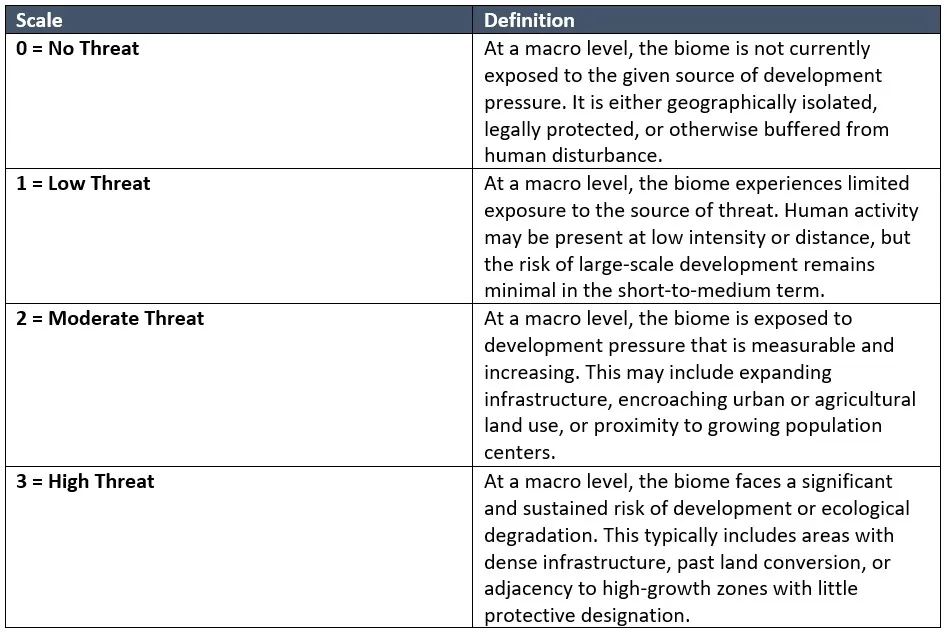
At a macro level, the biome faces a significant and sustained risk of development or ecological degradation. This typically includes areas with dense infrastructure, past land conversion, or adjacency to high-growth zones with little protective designation.
This ordinal scale ensures that all threat indicators are scored using a common language of ecological vulnerability, while still allowing for weighted influence in the final Threat Score calculation. Scores were assigned based on geospatial context, historical land-use data, and known development patterns across Canada.
Calculating the Threat Score
A weighted average was calculated for each biome to produce a Raw Threat Score, reflecting its relative exposure to development pressure across all five indicators. This calculation involved multiplying each indicator score (on a 0–3 scale) by its assigned weight, then summing the weighted values. The resulting Raw Threat Score captures the biome’s cumulative risk of land conversion and degradation based on spatial, historical, and policy-related factors.
To ensure consistency with other metrics in the framework, where higher values indicate more favorable conditions, the Raw Threat Score was inverted and normalized on a 0–10 scale. In this system, a score of 10 represents minimal development threat and high conservation integrity, while a score of 0 indicates significant exposure to development risk. The formula used is as follows:
Threat Score (0-10) = 10 – (Raw Threat Score / Maximum Weighted Score x 10)
Where:
- Raw Threat Score is the biome’s total weighted score across all five indicators
- Maximum Weighted Score is the theoretical maximum score a biome could receive (i.e., all indicators scored 3 and multiplied by their respective weights, totaling 3.0)
This normalization process creates a directly comparable score across biomes, regardless of their size, location, or ecological type. It also enables the Threat Score to be integrated seamlessly into a broader composite assessment of ecosystem value and risk, supporting evidence-based prioritization for conservation or investment.
2.7 Risk Assessment Balanced Score Across Categories
To prioritize biomes based on their investment potential and ecological urgency, a composite score was developed using three core dimensions: Biome Adjusted ROI per Acre, Risk of Extreme Events, and Threat Score. Each of these dimensions was normalized on a 0–10 scale and then combined into a single weighted score, using the following allocation:
- Biome Adjusted ROI per Acre – 80% weight
- Risk of Extreme Events (Resilience) – 10% weight
- Threat Score (Development Risk) – 10% weight
This weighting structure reflects a deliberate emphasis on financial return, under the rationale that investors and conservation finance practitioners are often most influenced by the efficiency and scale of ecological value generated per dollar invested. ROI is therefore prioritized as the primary driver of decision-making.
That said, ecological resilience, including the ability of a biome to withstand climate-related extreme events, and development threat, including the urgency to act before land is lost are also critical components. Their inclusion ensures that the model captures both long-term risk and near-term urgency, providing a more holistic view of investment potential.
Importantly, this weighting scheme is intentionally dynamic. It can be adjusted within the model based on investor preferences or institutional mandates. For instance, an investor focused on climate adaptation may choose to assign greater weight to risk scores, while a conservation-oriented fund might prioritize high-threat areas regardless of ROI. The flexibility of the framework allows it to serve a wide range of use cases across public, private, and philanthropic capital. It should be noted that, for the next section, the weighting above has been used to determine the Coastal Wetland as the optimal ecosystem to invest in.
2.8 Model Limitations and Next Steps for Refinement
While the model presented offers a structured, transparent approach to evaluating the ecological and financial value of Canadian biomes, it is important to acknowledge several limitations that may influence its precision and applicability including:
[1] Limited sample Size in ROI per Acre Estimation: The calculation of Biome Adjusted ROI per Acre is based on a curated sample of land listings across representative areas of each biome. While selecting a variety of listings and geographies was prioritized, the sample size remains relatively small. As a result, the average land values used in ROI estimates may not fully capture the range or distribution of prices within each biome, particularly in areas with low land turnover or limited public listings.
[2] Data Constraints in Extreme Event Risk Assessment: The assessment of risk from extreme climate-related events was derived from categorical scoring based on biome characteristics and general geographic exposure. While this provides a valuable baseline, the model could benefit from deeper integration of empirical datasets, such as historical insurance claims, government floodplain and wildfire zone maps, or catastrophe modeling tools. Incorporating these sources would help validate and refine the current scoring and ensure stronger geographic precision.
[3] Geographic Averaging within Biomes: The model treats each biome as a homogenous unit, assigning single scores for ROI, risk, and threat based on broad patterns. However, many Canadian biomes span large and ecologically diverse territories. For example, the Boreal Shield or coastal wetlands may exhibit very different land values, protection status, or development pressures depending on the province or subregion. This geographic averaging, while methodologically efficient, may mask meaningful local variation that could influence decision-making at a finer scale.
[4] Coarse Inputs in the Threat Framework: While the threat score methodology is grounded in sound indicators, such as proximity to urban areas, infrastructure, and land protection, it relies primarily on qualitative or categorical scoring. Integrating spatial datasets such as satellite imagery, development permit maps, or parcel-level infrastructure overlays could improve granularity and allow the model to better differentiate between regions with similar macro characteristics but different on-the-ground realities.
[5] Exclusion of Social and Indigenous Considerations: The current model does not incorporate social, cultural, or indigenous values, which are increasingly recognized as central to land stewardship and conservation planning. Many of Canada’s intact ecosystems are located in or near indigenous territories, and efforts to value or protect these landscapes should also consider indigenous governance, traditional knowledge, and consent. Future iterations of this model should aim to incorporate indigenous-led data, rights-based frameworks, and culturally informed priorities.
Despite these limitations, the model provides a strong foundation for evaluating and comparing biomes across Canada through a balanced lens of ecological value, resilience, and investment risk. It offers a replicable, transparent, and adaptable framework that can serve a range of stakeholders, from conservation finance professionals to public land planners and philanthropic investors.
Looking ahead, there are several promising pathways for refinement. First, expanding the underlying dataset, particularly for land values and ecosystem service valuation, would help improve the accuracy of the ROI calculations. Second, integrating spatially explicit data layers for infrastructure, historical disturbances, and climate risk could enhance the threat and resilience dimensions of the model. Lastly, meaningful engagement with indigenous communities and inclusion of rights-based or stewardship-informed variables would elevate both the legitimacy and impact of future assessments.
The model is designed to evolve. As new data sources, valuation methods, and social considerations become available, it can be recalibrated to support more targeted, just, and effective ecosystem investment strategies.
3 | Mobilizing the Ecosystem Perpetuity Fund and Pathway to Implementation
3.1 Section Abstract
This section outlines the strategic and operational blueprint to mobilize the Ecosystem Perpetuity Fund. Based on the findings from the custom-build valuation model, coastal wetlands in Eastern Canada, particularly in Nova Scotia, Newfoundland, and Prince Edward Island, emerge as the most compelling biome for initial investment. These ecosystems offer high ecological value, have a low land acquisition cost, and have reduced exposure to natural disaster risk relative to other biomes.
To mobilize this vision, the Fund will need to be established as a non-profit entity with a strong governance framework, supported by a five-member Board and an Executive Director. The financing approach to establishing the fund and associated endowment prioritizes ecological returns over financial gain, and therefore targets values-aligned contributions from High Net Worth Individuals (HNWIs), impact investors, and ESG-driven organizations. As mentioned, contributions will seed an endowment designed to cover both the upfront cost of land acquisition and annual operating needs, ensuring long-term financial stability.
To further strengthen data-driven stewardship and operational support, the fund will pursue a co-beneficial partnership with universities. These partnerships will enable field-based research, ecological monitoring, and educational programming, while enhancing transparency, scientific credibility, and long-term adaptability of the conservation strategy. Together, these components provide a clear and actionable framework for deploying the Ecosystem Perpetuity Fund, creating a replicable model for long-term, privately financed ecosystem preservation in Canada.

3.2 Overview of Target Biome for Investment: Coastal Wetlands
Based on the findings of the model, coastal wetlands in Canada have emerged as the most strategic biome for investment for the Ecosystem Perpetuity Fund. This decision, as outlined in the model, is informed by a combination of ecological value per acre of land, economic feasibility, and long-term risk mitigation. At a macro level, coastal wetlands provide critical ecosystem services, including carbon sequestration, flood mitigation, water filtration, and habitat for biodiversity. Despite their high ecological value and coastal properties typically being valued highly in the market, Eastern provinces in Canada, inclusive of Nova Scotia and Newfoundland, remain relatively undervalued in the land market, making them an attractive option from an investment perspective. The land acquisition cost being on average lower, relative to more populated or industrialized regions in Canada, can enable a higher return on investment, as more land can be secured and protected per dollar invested. Additionally, compared to other vulnerable biomes such as interior forests of fire-prone grasslands, coastal wetlands in this region are at a relatively lower risk of being severely impacted by natural disasters. Future phases of this initiative may explore other threatened biomes; however, for Fund 1 of the Ecosystem Perpetuity Fund, eastern coastal wetlands will be prioritized.
3.3 Perpetuity Fund Financing Vehicles and Value Proposition
The Ecosystem Perpetuity Fund is not designed to generate financial returns for investors. Instead, it offers an opportunity to make a high-impact environmental investment, preserving ecologically valuable land in perpetuity. Explicitly, the return is ecological: it focuses on protecting ecosystems with the highest intrinsic value, rather than those offering human-oriented economic gain. This novel approach, although unique, appeals to values-driven investors and organizations who have disposable income to prioritize legacy, sustainability, and climate resilience over financial gains.
To advance this initiative, the fund will seek support from both investors and institutions alike that are aligned with the value of long-term environmental impact. Potential Investor Profiles to explore include:
[1] High-Net-Worth Individuals (HNWIs):[1],[2],[3]Studies show, many HNWIs are increasingly supporting environmental causes as part of their philanthropic strategy, often driven by legacy, personal values, and a desire to create long-term impact. Current solutions, such as the Nature Conservancy, do not allow for traceability that these individuals are aspiring for, which creates a differentiated opportunity for the Fund, which would allow for a clear linkage of capital invested to protected land.
[2] Impact Investors:[4][5]While traditional impact investing is often focused on a blend of financial and social/environmental returns, shifts in funds and family office approaches are shifting, leading to some funds being open to zero-return environmental investments if the impact is quantifiable. Given the study's depth in quantifying financial value for the ecosystem, this Fund strategy would be aligned with the investment thesis of these organizations.
[3] Corporations with Net-Zero and ESG Goals/Targets:[6]Businesses in Canada are continuously experiencing heightened pressures to set goals and targets related to it’s net-zero and ESG ambitions. Investing in nature-based solutions and preservation of ecosystems can be a key part of organizations' ESG strategies and ambitions.
Although the fund will not generate profit, it does offer a strong non-financial value proposition, inclusive of:
[1] Perpetual Conservation Impact: Investments protect ecosystems in perpetuity, contributing to biodiversity preservation and climate resilience.
[2] ESG/CSR Alignment: The Fund can support corporate and institutional investors in meeting public sustainability goals and demonstrating climate action leadership.
[3] Reputational Benefits:[7]Associatingwith long-term conservation initiatives can, in turn, enhance brand equity, stakeholder trust, and an organization's public image.
[4] Legacy Creation: For individuals and families, the fund offers an opportunity to leave a lasting mark on Canada’s environmental future that can be passed down through generations.
In the next deployment phase of this work, identifying and engaging the right funders will be critical. Targeted outreach to HNWIs, Impact Funds, and value-aligned organizations with ESG or nature-based investment strategies should be focused on. Outreach can leverage existing conservation-aligned donor databases, leveraging networks within academic institutions and environmental nonprofits to build a pipeline for outreach efforts. Additionally, focusing on tailored messaging and aligned value propositions for each audience persona will be necessary to align interest and ultimately secure funding commitments.
3.4 Establishing a Non-Profit Entity
To effectively manage the perpetuity fund, a critical step is the development of a nonprofit organization. The nonprofit entity will be used for all functions of the perpetuity fund, inclusive of land acquisition and operational management. A robust governance structure will need to be established to ensure transparency, accountability, and the long-term execution of the perpetuity fund. A lean Board of Directors will be established, comprising of individuals with expertise in conservation, finance, law, and community engagement. Their primary responsibility in the short term will be to support diligence related to the acquisition of the land and the associated financial model for long-term operations. From a longer-term perspective, the Board will be leveraged to oversee financial management and support in selecting future leadership positions related to the yearly operations of the fund. Additionally, an Executive Director will be appointed on a 5-year term to prepare relevant materials related to the operation of the fund, and support in organizing contracting out services related to managing the endowment for operations, accounting, or other daily operational components of the perpetuity fund.
Establishing a non-profit involves several legal and regulatory steps, including:
[1] Incorporation[8]: Registering the organization federally under the Canada Not-for-profit Corporations Act. This process will include drafting supporting materials related to the incorporation and the applicable bylaws.
[2] Enroll in Charitable Status[9]: Apply to the Canada Revenue Agency (CRA) for charitable registration by submitting the T2050 form. This will support the fund in being able to issue tax receipts for donations, a critical step for receiving donations from HNWI’s.
[3] Once Established, Conduct Ongoing Compliance: Once established, conducting ongoing compliance through maintaining good standing by adhering to financial reporting standards and ensuring activities align with the stated charitable purpose will be integral. The responsibility of this will be executed by the appointed Executive Director.
3.5 Financial Model & Capital Requirements
As the progression of establishing the non-profit entity and identification of fundraising vehicles occurs, an integral step will be building the self-sustaining financial model designed to secure ecologically significant land and fund its protection in perpetuity. The model will combine a one-time capital outlay with a reserve mechanism that ensures annual operating costs are covered without relying on continuous fundraising. Given the economic volatility in markets, assumptions related to the endowment model and operating costs will need to be highly conservative.
The model will be comprised of two main components:
[1] One-Time Capital Cost: These include land acquisition and set-up related expenditures, such as legal fees and registration.
[2] Annual Operating Projections: This will capture recurring expenses necessary to manage and maintain the land, including property taxes, insurance, and administrative functions.
To ensure that the Fund will operate in perpetuity, key considerations will need to be taken while building the model, including:
[1] Upfront Capitalization: The total amount raised initially must cover the land acquisition cost and also seed the endowment that will be designed to generate annual returns for yearly operations. Given that the ecosystem to invest in is the Coastal Wetland, to identify land acquisition cost, it is suggested to work with a real estate agent in East Canada, to identify the average cost per acre of land with a higher sample size for entries to build additional confidence in the financial model. Once determined, a scaled approach can be built into the model to determine how much land, and the associated ecosystem value, can be derived based on the capital secured during fundraising.
[2] Endowment Model: As discussed, a portion of the upfront funding will be invested to generate stable returns that offset yearly operational costs. It is imperative that conservative estimates are used in establishing the yearly operating costs and expected returns from the market. A blended low-risk approach should be leveraged (e.g., investment in GIC’s) to minimize any risks in returns from the market.
3.6 Legal & Governance Framework
Building on the principles discussed to establish the non-profit entity, creating a robust legal and governance structure will support in execution of the non-profit in a way that ensures the Ecosystem Perpetuity Fund remains protected, well-managed, and aligned with the Fund’s mission of perpetuity.
A Fee Simple Ownership model is suggested for the operation of the land.[10]. This model will allow the non-profit entity to directly own the land outright, which in turn provides the highest level of control allowing for the organizational body (Board and Executive Director) to manage, monitor, and restrict land use as it sees fit.
In the long term, once land has been acquired, to continue to safeguard the conservation of the land, other long-term legal protection mechanisms can be applied. These include:
[1] Registering Easements: A conservation easement is a binding agreement that is registered on the land itself and restricts certain types of land use ultimately protecting its ecological value. These restrictions remain in place permanently, regardless of any future changes in governance or ownership, providing long-term assurance that the lands conservation purpose is upheld.
[2] Restrictive Covenants: A restrictive covenant is a legal clause attached to the land title that explicitly prohibits specified activities or uses, inclusive of resource extraction, construction, and commercial development. Like easements, these covenants stay with the land, remaining enforceable even if the property is transferred to another owner in the future. Covenants provide an additional layer of legal protection that supports the Fund’s mission through embedding conservation restriction directly into the properties legal framework.
As described, placing these easements and covenants on the land will prohibit certain uses of the land, even if ownership where to change.
As previously outlined, the elected Board of Directors will play a critical role in providing strategic oversight and financial stewardship of the Fund. The Board will also oversee the performance and management of the appointed Executive Director. The Board should consist of five members, each holding equal voting authority. Decisions, including those related to conflict resolution, will be made through majority vote.
The Executive Director will be responsible for managing the Fund’s day-to-day operations and will receive a nominal annual compensation package aligned with their responsibilities and outlined in the Financial Model. They will have the authority to engage external contractors, as needed, to execute the Fund’s yearly operational activities. Additionally, the Executive Director will be accountable for the effective year-over-year management of the Fund’s endowment to ensure long-term financial sustainability.
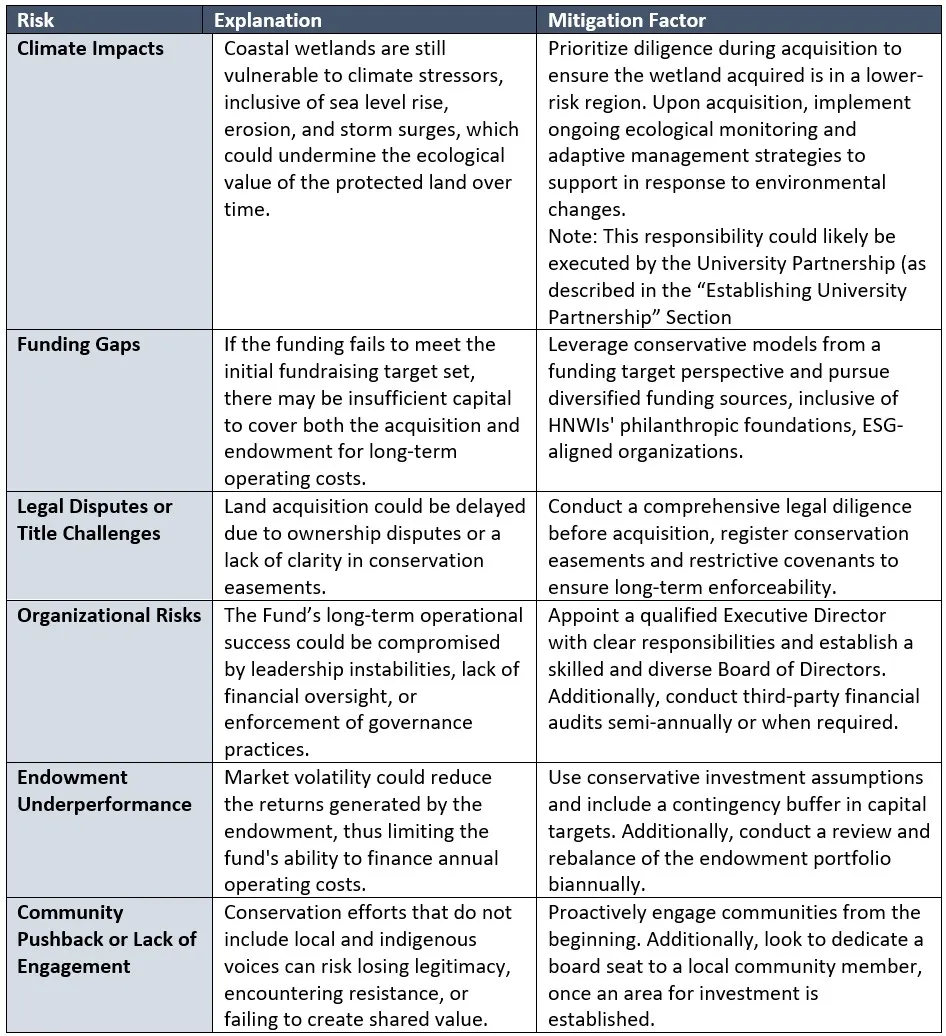
3.7 Risk & Mitigation Strategy
While the perpetuity fund is designed for long-term impact and conservation, there are still risks that could compromise the success of this fund, which need to be considered, monitored, and mitigated. Key risks, inclusive of their mitigation strategies, include:
3.8 Land Acquisition Strategy
Cost-effectively securing coastal wetlands is fundamental to the success of the Ecosystem Perpetuity Fund. A strategic approach to identifying and sourcing suitable coastal wetlands for acquisition has been highlighted below:
[1] Geographic Focus on Eastern Canada: The fund will prioritize land acquisition in eastern Canadian Provinces, focusing on Nova Scotia, Newfoundland and Labrador, and Prince Edward Island, due to the combination of ecological value and cost-effectiveness inclusive of lower land acquisition costs compared to central or western provinces, an abundance of intact coastal wetland ecosystems, and good proximity to coastal communities, and research institutions, providing strong opportunities for monitoring partnerships.
[2] Land Sourcing Channels: To identify suitable properties, the Fund should explore the following potential channels, inclusive of:
[2.1] Land Trust Partnerships: Collaborate with existing Canadian land trusts (e.g., the Nova Scotia Nature Trust) to identify high-priority parcels that might already be under assessment.
[2.2] Private Landowners: Engage with individual or families who own ecologically significant properties and may be interested in selling land for conservation purposes. Outreach can be facilitated through real estate advisors or local NGOs.
[2.3] Conservation Auctions or Listings: Monitor specialized auction platforms or brokerages that deal with environmentally sensitive land, including programs operated by government agencies or conservation-oriented real estate services.
Acquisition Due Diligence:
Before any acquisition is finalized, a comprehensive due diligence is required to assess both the ecological value and legal integrity of the parcel of land. Due diligence-based activities should include:
[1] Ecological Assessment: Conduct baseline studies to confirm the presence of key biodiversity features and habitat integrity.
[2] Legal Review: Verify clear title, zoning regulations, and land use history. Confirm the eligibility to register conservation easements or restrictive covenants.
[3] Pro-Active Risk Screening: Assess exposure to future development, erosion, or sea level rise using spatial planning and GIS tools.
3.9 Establishing University Partnership
To support long-term operations while creating an academic value of the Ecosystem Perpetuity fund, there is an opportunity to pursue a strategic partnership with a university or research institution. This partnership could offer a co-beneficial model: the Fund gains access to skilled resources and a robust data collection approach to monitor the land, while the university gains access to a living laboratory for education, research, and community engagement. Therefore, the Fund will seek to formalize a partnership with a university, ideally in close proximity and with a strong environmental science, sustainability, or conservation biology program. Potential candidates include Dalhousie University (Nova Scotia), Memorial University (Newfoundland), or the University of Prince Edward Island. Key components of the partnership could include, but are not limited to:
[1] Research Collaboration: Faculty and graduate students will conduct applied research on topics, such as biodiversity health, ecosystem services valuation, climate resilience, and wetland restoration techniques.
[2] Data Collection and Management: Students and researchers will support the collection and analysis of ecological data, contributing to the Fund’s annual reporting process (if pursued by the Board of Directors). Their work will also inform adaptive management strategies by identifying emerging climate-related risks and ensuring that timely conservation actions are taken as needed.
[3] Educational Programming: The site can be used as a field school or case study location for coursework, capstone projects, and experiential learning opportunities.
Co-Benefits
This collaboration would create meaningful value for both parties. For the fund, the partnership can offer access to research-trade data and ecological monitoring. This, in turn, can enhance the fund’s credibility, while supporting stronger transparency in stakeholder communications, and creating downside risk protection associated with any climate impacts that can be monitored during data collection activities. For the partner university, the partnership provides a field-based learning opportunity for students, offering a real-world environment to apply their skills and conduct hands-on research. It also establishes a dedicated site for long-term ecological studies and creates opportunities for faculty and students to publish findings and contribute to national conservation efforts.
3.10 Conclusion
The proposed pathway to implement the Ecosystem Perpetuity Fund offers a clear, actionable framework for preserving ecologically significant land in Canada, with long-term impact and financial sustainability. Grounded in the rigorous model to select the best biome to invest in, the strategy prioritizes high-value coastal wetlands in Eastern Canada, balancing the ecological return, affordability and resilience to climate threats.
Through the establishment of a mission-aligned nonprofit entity, a conservative endowment model, the Fund can operate independently and in perpetuity. Strategic legal protections and a transparent governance structure will ensure credibility, while university partnerships provide ongoing operational support and adaptive management through research and monitoring.
The perpetuity fund is not only a viable conservation vehicle, but also positioned as a replicable model for values-aligned environmental investments. In the next phase, the focus will be on activating fundraising channels, formalizing the nonprofit entity, creating the financial model, and identifying the first parcel of land for protection; setting the foundation for long-term ecological preservation in Canada.
4.1 Overview of Biomes Assessed in Analysis
Biome 1 | Coastal Systems[11],[12],[13],[14]
The Canadian coastal systems are some of the most ecologically important and biologically rich habitats in the nation, extending along Atlantic, Pacific, and Arctic coastlines. Estuaries, continental shelves, and seagrass beds are some of these features, all of which play a vital role in sustaining biodiversity, sustaining fisheries, and regulating climate. The combination of fresh and saltwater in estuaries makes them one of the most productive ecosystems in the world, offering essential breeding and feeding habitat for fish, migratory birds, and marine mammals. The Fraser River Estuary in British Columbia, an important rest stop on the Pacific Flyway, nurtures an astounding diversity of fish, and the St. Lawrence Estuary in Quebec is home to unusual marine life like the beluga whale. The high input of nutrients resulting from this makes estuaries central to commercial fisheries in addition to subsistence fisheries. But they are still vulnerable to pollution, habitat destruction, and sea level rise, which can damage the species and communities that depend on them.
Extending from the Canadian coast into the Atlantic, Pacific, and Arctic Oceans, the country's continental shelves support diverse marine ecosystems and rich fisheries. The shallow marine zones sustain fish stocks and high biodiversity, particularly in the biologically rich waters of the Scotian Shelf off Nova Scotia and the Grand Banks off Newfoundland. The upwelling of nutrient-dense waters in these regions favors the development of phytoplankton populations, which are the basis of marine food webs and sustain important fisheries such as cod, haddock, and lobster. Although historically the regions have been recognized for their high productivity, they increasingly confront threats of over-exploitation, ocean acidification, and alteration of marine ecosystems from climate change. The use of efficient management and conservation practices is vital to ensuring the long-term sustainability of these important marine resources.
Seagrass meadows, found in shallow, sheltered waters on Canada's Atlantic and Pacific coasts, provide essential ecological functions, including carbon sequestration, habitat creation, and coastal erosion protection. Composed of eelgrass-dominated subtidal meadows, they act as nurseries for fish, shellfish, and invertebrate juveniles, and support species that are valuable to commercial and ecological processes. In areas such as the Bay of Fundy in New Brunswick and the Gulf Islands of British Columbia, seagrass beds host populations of herring and salmon and general marine biodiversity. Despite their worth, these habitats are subject to an increasing number of threats posed by ocean warming, coastal development, and pollution, and therefore require targeted conservation and restoration.
Biome 2 | Coastal Wetlands[15],[16],[17],[18]
Coastal wetlands are some of Canada's most productive and ecologically significant ecosystems, with a key role in supporting biodiversity, enhancing water quality, and shielding shorelines from erosion. Coastal wetlands comprise tidal marshes, salt marshes, and saltwater wetlands, and are defined by the perpetual interaction of terrestrial and marine environments that form communities tolerant of changing water levels and salinity regimes. Along Canada's extensive coastlines, they provide essential breeding, feeding, and nursery habitats for fish, birds, and invertebrates as well as carbon sinks that regulate climate change.
Tidal marshes, which are created through the rise and fall of the ocean tides, are especially prominent in the Bay of Fundy, where the world's highest tides produce a dynamic environment characterized by mudflats and marsh vegetation. These types of wetlands are important rest stops for migratory bird species, such as the semipalmated sandpiper, which form large concentrations during seasonal migrations. The nutrient-rich aquatic ecosystems also sustain a variety of marine life, underpinning the productivity of adjacent fishing industries. Salt marshes, which line the Gulf of St. Lawrence and other coastlines, undergo periodic inundation by seawater, thereby fostering plant and animal communities specially adapted to brackish conditions. The ecosystems offer habitat for a variety of species, from shore birds to salt-tolerant vegetation that stabilizes coastlines against storm surges and sea level rise.
Although Canada does not have genuine mangrove forests because of its chilly climate, particular coastal wetlands, especially estuarine salt marshes and tidal wetlands, are serving identical ecological roles by providing secure refuges for fish, invertebrates, and water birds. Moreover, these wetlands serve a significant role in the water filtration system as they trap sediments and pollutants before they escape into open water. Despite their significance, coastal wetlands are coming under mounting pressure from land use change, pollution, and sea level rise as a result of climate change. Degradation of wetlands diminishes their capacity to sustain wildlife, sequester carbon, and guard against coastal erosion, making conservation and restoration efforts necessary to preserve these vital ecosystems.
Canada's coastal wetlands represent a vital component of the nation's natural heritage, yielding valuable ecological, economic, and climate resilience advantages. Conservation of the wetlands through sustainable land-use planning, restoration initiatives for habitats, and climate change adaptation is crucial to their long-term health and capacity to maintain support for biodiversity and coastal communities.
Biome 3 | Inland Wetlands[19],[20],[21]
Inland wetlands comprise some of Canada's most vital freshwater ecosystems, supporting fundamental processes including water purification, carbon sequestration, flood mitigation, and habitat provision for a myriad of species. The wetland traits are profoundly diverse, varying from nutrient-poor bogs to mineral-rich fens, herbaceous marshes, and woodland swamps. They occur scattered throughout the nation and form a central function in hydrological equilibrium, fostering biodiversity and adapting to the challenges imposed by climate change.
Bogs, which are widespread in Canada's boreal regions, are characterized by their acidic, water-saturated, and low-nutrient environments, promoting the long-term accumulation of peat. Such ecosystems provide conditions for the creation of landscapes that are dominated by moss and support species that are adapted to low-nutrient environments. In contrast, fens are peat-producing wetlands receiving nutrients from groundwater inflows, which enables them to sustain greater variability in vegetation, including sedges, shrubs, and trees. They are most frequent in the Mackenzie River Basin, where they contribute to regional diversity.
Marshes, which are characterized by the dominance of herbaceous vegetation like cattails and rushes, are found throughout Canada, with the Prairie Pothole Region being a key breeding area for migratory ducks and geese. Marshes play a key role in flood control as they absorb and gradually release water to avoid flooding downstream areas. Swamps, the most wooded of the inland wetlands, are found in areas like the Great Lakes–St. Lawrence Forest, home to numerous bird species, amphibians, and mammals. The wetlands are important for natural flood control and groundwater recharge.
Despite their key ecological roles, inland wetlands are facing increasing threats from urbanization, pollution, and global climate change. Conservation strategies, sustainable land-use practices, and wetland restoration activities are essential for the maintenance of these roles in water balancing, support of biodiversity, and climate variability.
Biome 4 | Fresh Water Systems[22],[23],[24]
Canada's freshwater systems, with their massive lakes and vast river networks, are among the most significant on Earth, shaping the nation's geography, climate, and biodiversity. The freshwater ecosystems provide drinking water, hydroelectric power, transportation routes, and vital habitat for millions of organisms. They also regulate regional climates and support Indigenous and local communities. Yet these habitats are ever more impacted by global warming, pollution, and human activities, and require sustainable management and conservation initiatives.
The Great Lakes, Canada's largest freshwater bodies, include Lakes Superior, Huron, Erie, and Ontario, which are shared with the United States. The lakes hold approximately 20 percent of the world's surface freshwater and are precious economic and environmental resources. They support large commercial fisheries, industrial commerce, and recreation, and provide drinking water for millions of Canadians. Despite their massive size, the Great Lakes are susceptible to pollution, invasive species, and climate change-induced water level and temperature fluctuations, all of which compromise the integrity of these ecosystems.
Apart from the Great Lakes, Canada is also home to numerous glacial lakes established in the last Ice Age. Some of them include Lake Winnipeg in Manitoba and Great Slave Lake in the Northwest Territories, both of which contain significant volumes of freshwater and are important natural reservoirs. Great Slave Lake, one of the deepest in North America, supports commercial fisheries and is critical habitat for Arctic and boreal biota, while Lake Winnipeg is a critical component of Manitoba's hydrologic system. Yet the lakes are becoming increasingly affected by agricultural runoff, nutrient loading, and algal blooms, which degrade water quality and disturb aquatic ecosystems.
Apart from its lakes, Canada is also defined by massive river systems that act as vital elements of freshwater ecosystems, promoting the flow of water, sediments, and nutrients through the environment. The Mackenzie River, which is the longest river system in Canada, drains a large area of the northern territories, supporting varied biological communities and acting as a fundamental drainage route for water into the Arctic Ocean. British Columbia's Fraser River is one of the world's most productive salmon rivers and is vital to Indigenous fisheries, commercial activities, and the marine ecosystem as a whole. Other key rivers, including the St. Lawrence, Saskatchewan, and Ottawa Rivers, supply essential freshwater and enable hydroelectric power production, irrigation, and transportation.
River ecosystems extend beyond the water itself, encompassing riparian zones such as vegetated riverbanks that provide critical habitat for fish, birds, and mammals. Those zones act as natural buffers, break erosion, filter pollutants, and moderate water temperatures. River ecosystems must be healthy to maintain biodiversity, as they support species such as beavers, otters, and migratory birds that depend upon freshwater habitats. However, river systems across Canada are coming under mounting pressure from dam construction, water utilization, and industrial pollution, which interfere with flow regimes, devastate habitat, and jeopardize fish populations.
Canada's freshwater rivers and lakes are an integrated ecosystem that sustains ecosystems, local communities, and economic activities. These aquatic resources need to be protected through strategies that prevent pollution, restore habitat, and provide sustainable management of water resources so that their sustained health and resiliency continue despite environmental hardships.
Biome 5 | Temperate Forest[25],[26],[27],[28]
Canada's temperate forests, spanning the country's coastal and eastern lands, are among the most ecologically productive and biodiverse ecosystems. They provide vital habitat for wildlife, global and local climate regulation via carbon sequestration, and significant economic and cultural practices, including forestry, tourism, and Indigenous land management. Despite their intrinsic resilience, temperate forests face increasing pressures from logging, land-use conversion, and climate change, making conservation a necessity for long-term ecosystem stability.
British Columbia's coastal temperate rainforests, among the world's most unusual forest ecosystems, thrive in the Pacific coast's mild, wet climate. Composed of huge conifers such as western hemlock, Sitka spruce, and Douglas fir, these forests receive some of the highest rainfall in North America, sustaining an ecosystem rich in biodiversity. The Great Bear Rainforest, the largest intact temperate rainforest in the world, is home to black bears, grizzly bears, and the rare Kermode, or "spirit" bear. The forests also support salmon-bearing rivers, which are keystone drivers of nutrient cycling and food webs. Coastal rainforests, despite their ecological importance, are increasingly threatened by industrial logging and infrastructure development, which fragment habitats and disrupt ecosystem processes.
In Eastern Canada, temperate deciduous forests dominate southern Ontario and Quebec landscapes, forming a dense mosaic of tree species that include maple, oak, birch, and beech. They undergo dramatic seasonal changes, with vibrant fall colors yielding to winter dormancy, only to spring to full foliage in the spring. Extremely biodiverse, they are home to a variety of mammals, birds, and amphibians, including white-tailed deer, black bears, barred owls, and salamanders. Eastern deciduous forests also provide the essential function of carbon sequestration and air filtration, mitigating the impacts of urbanization and industrialization. However, previous deforestation from agriculture and urbanization has reduced their cover much lower level, with most of the remaining forest patches vulnerable to invasive species, habitat degradation, and climate-induced species composition change.
Canada's temperate forests are not only ecologically significant but also intimately connected with Indigenous cultural practices, providing food, medicine, and materials for cultural use. Sustainable forest management, conservation efforts, and tree planting programs are key to maintaining the integrity of these forests while addressing economic needs. Protection of these landscapes ensures that they will continue to provide habitat, a buffer from climate change, and a source of ecosystem services for generations to come.
Biome 6 | Woodlands[29],[30],[31]
Canada's montane and boreal forests are critical transition ecosystems between closed forest cover and more open habitats, including tundra, grasslands, and alpine zones. The forests are fundamental to maintaining diverse wildlife, regulating local hydrological systems, and sequestering large volumes of carbon. They are coming under increasing pressure from climate change, wildfires, and resource development, making it necessary to implement sustainable management practices to ensure their ecological integrity in the long term.
Boreal woodlands, located in northern Canada, create a transition area between the closed boreal forest and the tundra. Scattered trees, shrubs, and lichen-covered ground characterize these woodlands, which are influenced by severe climatic conditions, such as short growing seasons, permafrost, and infertile soils. Black spruce, tamarack, and jack pine are the dominant features of these landscapes, which offer critical cover for caribou, lynx, and snowy owls. They are important carbon sinks through the sequestration of carbon due to the slow decomposition of organic material in cold climates, which results in extensive peat deposits. Boreal forests are very susceptible to climate change, with warming temperatures resulting in permafrost melting and species range shifts. Their stability is further endangered by more frequent wildfires, which speed up habitat destruction and alter the fire-adapted ecosystem dynamics of these environments.
Montane woodlands, found in the interior regions of British Columbia and Alberta, are shaped by mountainous terrain, variable precipitation, and a mix of coniferous tree species. Dominated by drought-tolerant trees such as Douglas fir and ponderosa pine, these forests thrive in drier, lower-elevation areas before transitioning into denser mountain forests at higher altitudes. Montane woodlands provide critical habitat for elk, bighorn sheep, and cougars while supporting diverse bird populations. Fire represents a fundamental and necessary phenomenon within these ecosystems, facilitating the maintenance of open-canopy environments and inhibiting the invasion of more densely populated forest species. Nevertheless, the human intervention in curtailing natural fire cycles, coupled with the rising intensity of wildfires attributable to climate change, has resulted in disruptions to ecosystem dynamics, characterized by the buildup of dry fuel and the proliferation of pests such as the mountain pine beetle.
Both montane and boreal forests are important ecological buffers that promote biodiversity, buffer climate change variability, and facilitate traditional Indigenous land uses. In light of increasing pressures on these ecosystems, conservation of these ecosystems along with the implementation of adaptive forest management and climate resilience initiatives is essential to ensure their ecological integrity and services.
Biome 7 | Grasslands[32],[33],[34],[35]
Canada's grasslands, though covering a smaller area compared to grasslands, are known to be among the most ecologically and economically valuable ecosystems in the country. These open landscapes support a diverse array of plant and animal species, provide vital habitat for species at risk, and form the foundation of Canada's agricultural industry. Despite their resilience, grasslands are among the most threatened ecosystems in Canada, facing extensive habitat loss due to agricultural expansion, urbanization, and changes in precipitation regimes induced by climate change.
The short-grass prairie grasslands common in southern Alberta, Saskatchewan, and Manitoba are characterized by a heterogeneous mixture of short, mixed, and tall grasses that have adapted to the semi-arid climate and sporadic periods of drought in the area. These communities historically supported large herds of bison, which played a critical role in maintaining the health of the grasslands by preventing tree invasion and promoting nutrient cycling. Today, prairie grasslands continue to harbor such species as pronghorn antelope, burrowing owls, and swift foxes, in addition to being perfect cropland for wheat, canola, and cattle grazing. Fewer than 20 percent of Canada's original native prairie remains intact due to massive land conversion. The decline of the native grasses with deep root systems has diminished soil stability, heightened erosion risks, and minimized the carbon storage potential of the ecosystems, so that conservation became crucial to conserve their ecological as well as agricultural importance.
Montane grasslands, which are found in the interior valleys of British Columbia, are discrete dryland ecosystems characterized by the accompanying occurrence of grasses, shrubs, and isolated trees in an ecosystem conditioned by rain shadows of adjacent mountain complexes. Montane grasslands support specialized flora and fauna diversity that spans species from bunchgrasses and sagebrush to more restricted organisms such as the bighorn sheep and western rattlesnake. In contrast to the extensive prairie grasslands, montane grasslands occur in smaller fragments and are very susceptible to land-use change, invasive species, and fire suppression. The natural influence of periodic wildfires that historically sustained these ecosystems has been impaired, resulting in encroachment by trees and shrubs that change the composition of native plant assemblages.
Grasslands are among the most imperiled ecosystems in Canada; however, they play a key role in maintaining biodiversity, controlling local climates, and underpinning both Indigenous communities and agriculture. Restoring native prairie, implementing sustainable grazing practices, and protecting the remaining patches of grassland are essential for maintaining the productivity and ecological function of these landscapes in the face of escalating environmental pressures.
Conclusion
The integrity of Canada’s biomes is essential to the nation’s environmental health, economic resilience, and cultural identity. As climate change, habitat loss, and industrial activity place a growing strain on these ecosystems, proactive conservation and sustainable land-use practices will be critical in ensuring their long-term stability. Whether through the protection of freshwater resources, the restoration of prairie grasslands, or the sustainable management of forests and wetlands, maintaining these landscapes is a shared responsibility. By prioritizing ecological preservation and adapting to environmental challenges, Canada can continue to support the richness of its natural world while ensuring these landscapes remain vibrant and functional for generations to come.
4.2 Category 2 Risk of Extreme Events – Defining Extreme Event Categories
Defining Extreme Event Categories
The first step involved identifying the major categories of extreme events that pose a threat to Canadian ecosystems. These include both climatic and ecological hazards known to vary by geography and biome type. The key categories considered were:
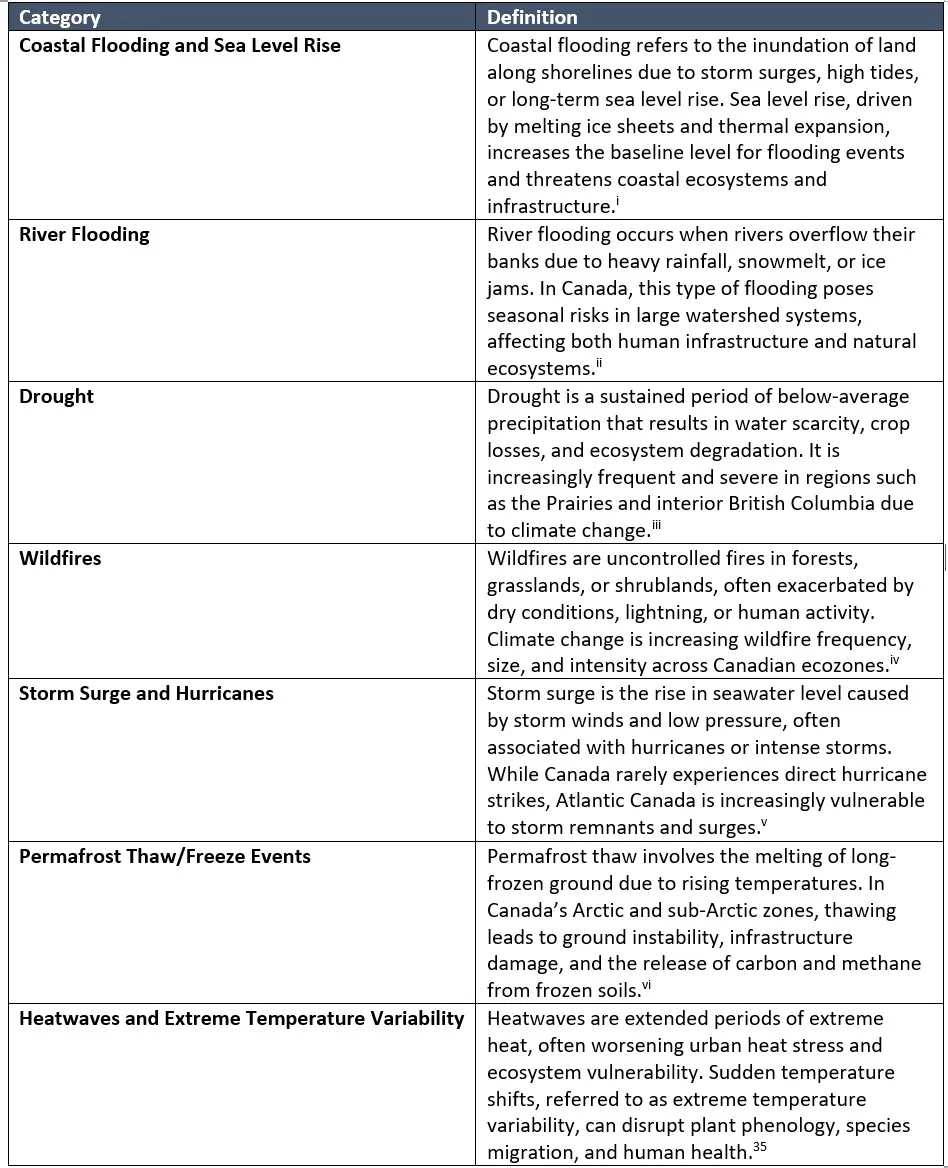
These categories were selected based on scientific literature, climate risk assessments, and national climate adaptation reports specific to Canada. Each event type was mapped to the biomes most likely to be affected, ensuring that the risk scoring reflects biome-specific exposure.
4.3 Category 3 Threat Score – Indicator Framework Inputs
[1] “The Rise of High-Net-Worth Giving: Impacts on U.S. Foundations.” Funds for NGOs, 3 Feb. 2025, https://us.fundsforngos.org/articles/the-rise-of-high-net-worth-giving-impacts-on-u-s-foundations/.
[2] “The HNWIs’ Pursuit of Social Impact and Sustainability in Luxury.” Affluential, 16 Sept. 2024, https://affluential.com/the-hnwis-pursuit-of-social-impact-and-sustainability-in-luxury.
[3] McGrath, Kevin. “Giving Motivations of HNW and UHNW May Surprise Financial Institutions.” Ren, 2 Feb. 2023, https://www.reninc.com/giving-motivations-of-hnw-and-uhnw-may-surprise-financial-institutions/.
[4] Bugg-Levine, A., & Emerson, J. (2011). Impact investing: Transforming how we make money while making a difference. John Wiley & Sons.
[5] Combs, K. “More Than Just a Trend: The Importance of Impact Investing.” Corporate Finance Review, vol. 18, no. 6, 2014, pp. 12–18. ProQuest, https://www.proquest.com/scholarly-journals/more-than-just-trend-importance-impact-investing/docview/1548696618/se-2.
[6] Semenova, Galina. “Investment in Ecology to Preserve the Environment.” E3S Web of Conferences, vol. 284, 2021, Article no. 11010, https://www.e3s-conferences.org/articles/e3sconf/abs/2021/60/e3sconf_tpacee2021_11010/e3sconf_tpacee2021_11010.html.
[7] Agu, Edith Ebele, et al. “Exploring the Relationship Between Sustainable Business Practices and Increased Brand Loyalty.” International Journal of Management & Entrepreneurship Research, vol. 6, no. 8, Aug. 2024, pp. 2463–2475. Fair East Publishers, https://www.researchgate.net/profile/Tochukwu-Ijomah-2/publication/383847817_Exploring_the_relationship_between_sustainable_business_practices_and_increased_brand_loyalty/links/66dc447d2390e50b2c7212e7/Exploring-the-relationship-between-sustainable-business-practices-and-increased-brand-loyalty.pdf.
[8] “Creating a Not-for-Profit Corporation.” Corporations Canada, Innovation, Science and Economic Development Canada, 21 July 2022, https://ised-isde.canada.ca/site/corporations-canada/en/not-profit-corporations/creating-not-profit-corporation.
[9] Wright, Nicholas dePencier. “How to Incorporate and Register a Charity Canada.” Wright Business Law, 17 Nov. 2024, https://wrightbusinesslaw.ca/how-to-incorporate-and-register-a-charity-canada/.
[10] Blomley, Nicholas. “Making Space for Property.” Annals of the Association of American Geographers, vol. 104, no. 6, 2014, pp. 1291–1306, https://doi.org/10.1080/00045608.2014.941738.
[11] Benkler, Yochai. “Coase’s Penguin, or, Linux and the Nature of the Firm.” Yale Law Journal, vol. 112, no. 3, 2003, pp. 369–446. https://citeseerx.ist.psu.edu/document?repid=rep1&type=pdf&doi=f90a5f47f0d0b32ecfe4285bf17e05d6857e5039.
[12] Fricker, Alan, and Donald L. Forbes. “A System for Coastal Description and Classification.” Coastal Management, vol. 16, no. 2, 1988, pp. 111–137, https://doi.org/10.1080/08920758809362052.
[13] Breen, Sarah-Patricia. “Governing Sustainable Coastal Development: The Promise and Limitations of Collaborative Governance in Canada.” The Canadian Geographer, vol. 58, no. 2, 2014, pp. 146–158. https://doi.org/10.1111/cag.12135.
[14] Freedman, Bill. “Chapter 8 ~ Biomes and Ecozones.” Environmental Science: A Canadian Perspective, Dalhousie University Libraries Digital Editions, 27 Aug. 2018, https://ecampusontario.pressbooks.pub/environmentalscience/chapter/chapter-8-biomes-and-ecozones/
[15] Navarro, Nuria, and Inmaculada Rodríguez-Santalla. “Coastal Wetlands.” Journal of Marine Science and Engineering, vol. 11, no. 4, 2023, article 767, https://www.mdpi.com/2077-1312/11/4/767.
[16] Glooschenko, W. A., C. Tarnocai, S. Zoltai, and V. Glooschenko. “Wetlands of Canada and Greenland.” Wetlands of the World: Inventory, Ecology and Management, vol. 1, edited by Dennis F. Whigham, Dennis Dykyjová, and Slavomil Hejný, Springer, 1993, pp. 415–514. https://link.springer.com/chapter/10.1007/978-94-015-8212-4_11.
[17] National Research Council of Canada. “National Building Code of Canada 1990.” Canadian Building Digest, no. 241, 1992, https://www.sciencedirect.com/science/article/pii/S0380133092713215.
[18] Tiner, Ralph W., et al. “Mapping Floating and Emergent Aquatic Vegetation in Coastal Wetlands Using Airborne Hyperspectral Imagery.” Wetlands, vol. 30, no. 3, 2010, pp. 583–592. https://doi.org/10.1007/s13157-010-0105-z
[19] Davidson, Scott J., et al. “The Unrecognized Importance of Carbon Stocks and Fluxes from Swamps in Canada and the USA.” Environmental Research Letters, vol. 17, no. 5, 2022, article 053003, https://doi.org/10.1088/1748-9326/ac63d5.
[20] Reis, V., Hermoso, V., Hamilton, S. K., Ward, D., Fluet-Chouinard, E., Lehner, B., & Linke, S. “A Global Assessment of Inland Wetland Conservation Status.” BioScience, vol. 67, no. 6, 2017, pp. 523–533. https://doi.org/10.1093/biosci/bix045.
[21] Kolka, Randall, et al. “Terrestrial Wetlands.” Second State of the Carbon Cycle Report (SOCCR2): A Sustained Assessment Report, edited by N. Cavallaro et al., U.S. Global Change Research Program, 2018, pp. 507–567. https://doi.org/10.7930/SOCCR2.2018.Ch13
[22] Williams, John W., et al. “Late Quaternary Biomes of Canada and the Eastern United States.” Journal of Biogeography, vol. 27, no. 3, 2000, pp. 585–607. https://doi.org/10.1046/j.1365-2699.2000.00428.x
[23] Desforges, Jessica E., et al. “The Alarming State of Freshwater Biodiversity in Canada.” Canadian Journal of Fisheries and Aquatic Sciences, vol. 79, no. 2, 2022, pp. 352–365. https://doi.org/10.1139/cjfas-2021-0073.
[24] Prowse, Terry D., Chris Furgal, Fred J. Wrona, and James D. Reist. “Implications of Climate Change for Northern Canada: Freshwater, Marine, and Terrestrial Ecosystems.” Ambio, vol. 38, no. 5, 2009, pp. 282–289. https://doi.org/10.1579/0044-7447-38.5.282.
[25] Kuennecke, Bernd H. Temperate forest biomes. Bloomsbury Publishing USA, 2008.
[26] Hember, Robbie A., Werner A. Kurz, and Nicholas C. Coops. "Increasing net ecosystem biomass production of Canada's boreal and temperate forests despite decline in dry climates." Global Biogeochemical Cycles 31.1 (2017): 134-158.
[27] Thomas, Sean C., and James MacLellan. "Boreal and temperate forests." Forests And Forest Plants-Volume I (2009): 152.
[28] Carcaillet, Christopher, et al. "Fire and soil erosion history in East Canadian boreal and temperate forests." Quaternary Science Reviews 25.13-14 (2006): 1489-1500.
[29] Williams, John W., et al. "Late Quaternary biomes of Canada and the eastern United States." Journal of Biogeography 27.3 (2000): 585-607.
[30] Roberts, Bruce A., Neal PP Simon, and Keith W. Deering. "The forests and woodlands of Labrador, Canada: ecology, distribution and future management." Ecological Research 21 (2006): 868-880.
[31] Scott, Daniel, Jay R. Malcolm, and Christopher Lemieux. "Climate change and modelled biome representation in Canada's national park system: implications for system planning and park mandates." Global Ecology and Biogeography 11.6 (2002): 475-484.
[32] Axelrod, Daniel I. "Rise of the grassland biome, central North America." The Botanical Review 51 (1985): 163-201
[33] Axelrod, Daniel I. "Rise of the grassland biome, central North America." The Botanical Review 51 (1985): 163-201.
[34] Shorthouse, Joseph D., and David J. Larson. "Grasslands and grassland arthropods of Canada." Arthropods of Canadian grasslands 1 (2010): 1-24.
[35] Woodward, Susan L. "Grassland biomes." (2008): 1-176.
[36] Pörtner, Hans-Otto, et al., editors. Climate Change 2022: Impacts, Adaptation and Vulnerability. Contribution of Working Group II to the Sixth Assessment Report of the Intergovernmental Panel on Climate Change. Cambridge University Press, 2022, https://www.ipcc.ch/report/ar6/wg2/downloads/report/IPCC_AR6_WGII_Chapter13.pdf.
[37] Masson-Delmotte, Valérie, et al., editors. Climate Change 2021: The Physical Science Basis. Contribution of Working Group I to the Sixth Assessment Report of the Intergovernmental Panel on Climate Change. Cambridge University Press, 2021, https://www.ipcc.ch/report/ar6/wg1/downloads/report/IPCC_AR6_WGI_Chapter11.pdf.
[38] Pörtner, Hans-Otto, et al., editors. Climate Change 2022: Impacts, Adaptation and Vulnerability. Contribution of Working Group II to the Sixth Assessment Report of the Intergovernmental Panel on Climate Change. Cambridge University Press, 2022, https://www.ipcc.ch/report/ar6/wg2/downloads/report/IPCC_AR6_WGII_Chapter04.pdf.
[39] Pörtner, Hans-Otto, et al., editors. Climate Change 2022: Impacts, Adaptation and Vulnerability. Contribution of Working Group II to the Sixth Assessment Report of the Intergovernmental Panel on Climate Change. Cambridge University Press, 2022, https://www.ipcc.ch/report/ar6/wg2/downloads/report/IPCC_AR6_WGII_Chapter02.pdf.
[40] Masson-Delmotte, Valérie, et al., editors. Climate Change 2021: The Physical Science Basis. Contribution of Working Group I to the Sixth Assessment Report of the Intergovernmental Panel on Climate Change. Cambridge University Press, 2021, https://www.ipcc.ch/report/ar6/wg1/downloads/report/IPCC_AR6_WGI_Chapter11.pdf.
[41] Pörtner, Hans-Otto, et al., editors. Climate Change 2022: Impacts, Adaptation and Vulnerability. Contribution of Working Group II to the Sixth Assessment Report of the Intergovernmental Panel on Climate Change. Cambridge University Press, 2022, https://www.ipcc.ch/report/ar6/wg2/downloads/report/IPCC_AR6_WGII_Chapter14.pdf.
[42] Masson-Delmotte, Valérie, et al., editors. Climate Change 2021: The Physical Science Basis. Contribution of Working Group I to the Sixth Assessment Report of the Intergovernmental Panel on Climate Change. Cambridge University Press, 2021, https://www.ipcc.ch/report/ar6/wg1/downloads/report/IPCC_AR6_WGI_Chapter11.pdf.
About the Author
Andrew Boughner’s professional career has been rooted in management consulting at Bain & Company, where he supports executive teams in improving performance and addressing complex organizational challenges. He is a 2025 graduate of Columbia University’s M.S. in Sustainability Management program, where he completed an independent study on the creation of the Ecosystem Perpetuity Fund. In this project, he developed an impact-driven investment framework to create innovative approaches for channeling private capital toward the permanent protection of Canada’s most ecologically valuable and threatened ecosystems.