
Nevada North Lithium Project: Regional Cost-Benefit Analysis
Written by Annabel Gibson and Melale Hailu
SUMA PS5020 Cost-Benefit Analysis Final Report - Spring 2025
Advised by Dr. Anyi Wang
Executive Summary
The Nevada North Lithium Project (NNLP) in Elko County, Nevada, represents a significant opportunity to strengthen domestic lithium supply chains, reduce import dependency, and contribute to clean energy transitions. This report presents an ex-ante Cost-Benefit Analysis (CBA) of the NNLP from the perspective of the State of Nevada, comparing a 40-year mine operation scenario to a counterfactual scenario in which lithium continues to be imported into the state.
The CBA uses a hybrid two-phase discounted cash flow model incorporating market-based, proxy, and literature-backed valuation methods. Under conservative assumptions, including a 5% real discount rate, operating and capital costs based on analogous projects, and a robust Monte Carlo simulation of uncertainties, the NNLP generates substantial net social benefits. Key results include:
- Net Present Value (NPV): $55.8 billion (base case, 5% discount rate)
- Benefit-Cost Ratio (BCR): 3.57 (with economic multipliers) or 3.22 (excluding multipliers)
- Sensitivity Analysis: Project remains net beneficial across a wide range of discount rates and profit assumptions
- Monte Carlo Simulation: Average NPV $56.2 billion; confirms robustness of the base case
Given these substantial net benefits, we recommend that the project proceed, subject to implementation of strict environmental and social safeguards, including comprehensive water management plans, biodiversity offsetting, and ongoing monitoring, to ensure sustainable and equitable outcomes for Nevada.
Introduction and Background
Lithium has become a strategic resource in the global push toward clean energy and technological leadership[1]. Yet, its large-scale extraction continues to be the subject of debate. While lithium mining offers clear potential to accelerate the green energy transition and deliver economic gains, it also risks generating or intensifying environmental degradation and social disruption. The Nevada North Lithium Project (NNLP)—one of the most prominent proposed lithium mines in the U.S.—embodies this tension between opportunity, intent, and impact. This ex-ante cost-benefit analysis seeks to determine whether the NNLP’s projected benefits outweigh its potential costs and decide whether the project should proceed to full-scale operations.
Project Overview and Wider Context
The NNLP, located 73 km northeast of Wells in Elko County, Nevada, is a lithium exploration initiative led by Surge Battery Metals USA[2]. This private U.S. company aims to reduce dependence on foreign critical minerals by developing a high-grade lithium supply supporting national clean energy goals. The project targets shallow hectorite clay deposits, geologically similar to those at Thacker Pass[3]—and is considered one of the highest-grade lithium clay resources in the country[4]. To date, three rounds of drilling have identified approximately 4.67 million tons of lithium carbonate equivalent[5]. The Bureau of Land Management approved a three-year exploration phase in 2024, with full-scale mining projected to begin post-2027, pending confirmation of commercial viability and additional permitting. The mine is expected to operate for 40 years, with production ramping up to 60,000 tons annually after an initial lower-output phase.
The NNLP aligns with a broader policy shift toward domestic mineral independence, as demand for lithium is set to quadruple by 2030, and the U.S. remains heavily reliant on imports[6]. Strengthening U.S.-based production has become a national priority, supported by provisions in the Inflation Reduction Act (IRA) and federal energy security objectives[7]. Positioned to contribute directly to this agenda, the NNLP offers a significant opportunity to enhance supply chain resilience through in-state production.
Standing & Stakeholder Perspectives
Adopting a state lens, this CBA evaluates the direct impact of the NNLP on Nevada’s economy, environment, and society. However, various stakeholders shape both the distribution and perception of these impacts. The most relevant perspectives include:
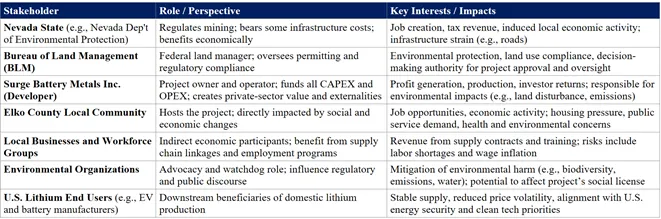
Understanding these stakeholder dynamics is crucial for evaluating the broader implications of NNLP and informing balanced policy recommendations.
Alternatives and Counterfactual
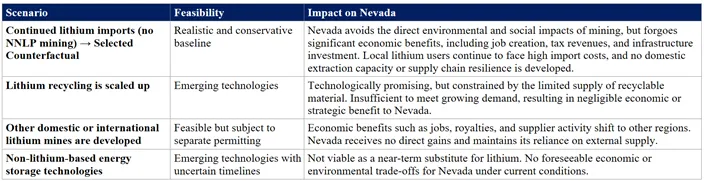
This cost-benefit analysis adopts a counterfactual scenario in which no full-scale mining occurs to evaluate the net benefits of the NNLP. In this baseline case, Nevada continues to rely on imported lithium rather than developing in-state production. This was ultimately selected as the base case counterfactual because it provides a realistic and conservative projection of current conditions and directly compares local impacts across economic, environmental, and social dimensions to assess NNLP’s potential value. Although the NNLP may influence national or global markets, this analysis deliberately limits state-level outcomes relevant to Nevada.
In addition to the selected counterfactual, three alternative scenarios were considered. Each represents a plausible lithium supply or energy storage pathway without NNLP, but with differing implications for Nevada’s economy and policy goals. The table below summarizes the feasibility and expected local impacts of each scenario:
Baseline and Timeframe
This analysis models the Nevada North Lithium Project (NNLP) over a 40-year operational horizon, structured into three distinct phases reflecting the project's capital intensity and production trajectory:
Phase 1: Construction and Early Development (Years 1–4):
This period is capital-expenditure (CAPEX) intensive, as major infrastructure and processing facilities are developed. Lithium output during this phase is minimal, reflecting early-stage exploration and site preparation.
Phase 2: Ramp-Up and Transition to Operations (Years 4–7):
Phase 3: Steady-State Operations (Years 7–40):
While CAPEX-intensive, Phase 2 sees a decline in upfront investment as construction nears completion. Lithium production begins and steadily increases, approaching full capacity by the end of this period.
From Year 7 onward, the project enters its steady-state phase. CAPEX requirements are reduced significantly and limited to sustaining investments, while lithium output remains stable. This phase represents the business-as-usual (BAU) operational period over the remaining project life.
This phased structure underpins the cost-benefit model, enabling more accurate estimation of temporal changes in expenditures, output, and associated externalities. All monetary values in this analysis are expressed in constant 2024 U.S. dollars.
Proxy Rationale and Existing Studies
Given that the NNLP is still in the exploration phase, this CBA relies on a proxy-based approach to estimate project-specific costs, benefits, and externalities. Where primary data was unavailable, we used values derived from comparable lithium mining operations, academic literature, and industry reports.
The Thacker Pass Project in Humboldt County, Nevada, was the principal benchmark throughout this analysis. Its geological similarities, comparable extraction methods (clay-based lithium mining), and publicly available technical and economic studies made it a reliable and contextually appropriate proxy[8]. Cost categories such as CAPEX, OPEX, employment multipliers, land disturbance, and emissions intensity were all informed by Thacker Pass data, adjusted where appropriate to reflect NNLP’s specific scale and location.
In addition to Thacker Pass, this analysis draws on estimates from the U.S. Environmental Protection Agency (e.g., the Social Cost of Carbon), industry forecasts for lithium pricing (e.g., Wood Mackenzie, Goldman Sachs), and government sources such as the Bureau of Land Management (BLM) for regulatory timelines and permitting assumptions.
While proxy use introduces some uncertainty, this method allows for a transparent and conservative valuation of NNLP’s potential impacts, enabling informed decision-making without final feasibility data.
Methodology
We adopted a hybrid two-phase model to estimate NNLP’s costs and benefits, adjusting financial and externality calculations over time. This model enhances accuracy over a static model, considering changing market conditions, environmental impacts, and community responses throughout the project's lifespan. Our selected methodologies, rationale, and data sources are discussed below. Direct stated preference methods were excluded due to feasibility constraints and the lack of prior NNLP-specific studies.
2Categorization of Project Impacts
Since this CBA is from the statewide perspective of Nevada, costs and benefits are categorized based on their net impact on Nevada’s economy, environment, and society. For simplicity and to maintain a conservative approach, we assume that all economic activity related to NNLP occurs within Nevada, ensuring our analysis captures the full potential local economic effects. We note that some state costs may be overestimated since they may be partially incurred or financed by Surge Battery’s operations outside of Nevada. Our primary sources for developing our categorization and methodologies were the Thacker Pass feasibility and economic impact studies (Lithium Americas Corp., 2023; Borden & Harris, 2023).
Estimation Methods
Economic Impacts: (Costs) / Benefits
Economic impact monetization drew heavily on the Thacker Pass project as a proxy.[9]
Capital Expenditures (CAPEX) – $(6,168)M
The CAPEX methodology was structured in three phases to reflect changing investment intensity across the project lifecycle. Table 3 summarizes the cost estimates, timing, and sources used. This phased approach aligns closely with NNLP’s production ramp-up and operational trajectory.

Land Purchase – $(223)M
Land acquisition costs were separated from CAPEX to avoid double counting. This one-time cost was allocated across Years 1–2 and reflects estimates based on local land values and the project footprint.
Operating Expenditures (OPEX) – $(36,190)M
Infrastructure Damage & Road Repair – $(160)M
Surge Battery Metals EBIT – $180,588M
Indirect Job Creation – $3,473M
Annual OPEX during the steady state (from Year 7) was estimated at $961 million, consistent with unit cost benchmarks from Thacker Pass. Earlier-phase OPEX was proportionally scaled based on output.
Increased truck traffic from NNLP operations is expected to impose long-term wear on approximately 20 miles of local access roads. A flat-rate estimate of $200,000 per lane-mile per year, drawn from the higher end of NDOT’s published maintenance cost range, was applied to reflect conservative assumptions. This results in an annual infrastructure cost of $4 million, which will continue throughout the project's life.
Company earnings before interest and tax (EBIT) were modeled from projected lithium carbonate output (up to 60,000 tons/year) and price forecasts escalating from $11,000 to $20,500/ton. CAPEX was depreciated over 40 years; sustaining CAPEX over 5 years. Federal taxes (21%) were deducted, while state taxes were excluded as internal transfers.
Employment multipliers derived from the Thacker Pass economic impact analysis were applied to project-induced employment in construction and operations. Total job-years were estimated at 2,080 during construction and 1,138 ongoing, with average wages of ~$66,900/year.
Environmental Impacts: (Costs) / Benefits
Environmental impacts similarly used the Thacker Pass project to estimate figures for resource consumption.
Water Depletion - $(129)M
Given Nevada’s limited groundwater availability, water depletion is a critical environmental concern. The Thacker Pass Feasibility Study was used to approximate NNLP’s water demand. Based on this proxy, NNLP is expected to use approximately 2,600 acre-feet/year in Phase 1 and 5,200 acre-feet/year in Phase 2. A treatment cost proxy of $0.002 per gallon was applied to value this impact, based on EPA treatment cost estimates for mining-influenced water[10]. This yields a water depletion cost of $1.69 million/year in Phase 1 and $3.39 million/year in Phase 2. No adjustments for scarcity pricing or regional recharge rates were made, making this a conservative estimate. Water contamination costs were excluded to avoid double-counting (they are included in OPEX).
Increased Greenhouse Gas Emissions - $(1,042)M
Land Degradation & Habitat Loss - $(82)M
Reduced Import-Related Mining Emissions - $3,813M
NNLP is expected to generate substantial greenhouse gas emissions due to energy-intensive processes such as sulfuric acid leaching, waste rock removal, and heavy vehicle transport. Greenhouse gas emissions from NNLP operations were monetized using estimated annual CO2 emissions across construction, operation, and transport phases.
Emission volumes were derived from Thacker Pass and converted from short tons to metric tonnes using the EPA’s standard factor (1 short ton = 0.90718474 metric tonnes[11]). A $190 per metric tonne CO2e social cost of carbon (SCC) was applied, derived from the U.S. EPA’s 2023 proposed update[12]. The cost of emissions is estimated at $5.9 million/year for Years 1–2 (construction and early operations), $16.1 million/year during Years 1–4 (operations and transport), and $26.8 million/year from Year 5 onward (steady-state operations and off-site emissions).
Land degradation and habitat loss were monetized by estimating total disturbed acreage based on NNLP’s projected production and applying a restoration cost proxy. Using Thacker Pass data, where 32% of the total project area (5,695 acres of 17,933) is disturbed, the same disturbance ratio was applied to NNLP’s project area (12,890 acres), yielding an estimated 4,093 acres of land disturbed.
Based on a concurrent reclamation approach, restoration is assumed to occur progressively in line with production output. A restoration cost of $20,000 per acre, sourced from Restoration Cost as a Proxy for Ecosystem Value (2023), was applied annually across the 40-year life of the mine. This results in a total monetized land restoration cost of $81.87 million, with restoration activities and costs scaling proportionally with production. This estimate does not capture non-market ecological or cultural values (e.g., species loss or sacred land), which are addressed qualitatively.
Producing lithium carbonate locally rather than relying on imports offers environmental benefits by avoiding emissions associated with long-distance transportation. To quantify this benefit, we apply an average lifecycle transportation emission factor of 1.85 tonnes of CO2 per tonne of lithium carbonate[13] and the SCC of $190 per tonne of CO2[14]. This results in a monetized climate benefit ranging from $25.5 million in Year 1 to $102 million annually from Year 7 onward, totaling a significant avoided emissions value over the project’s life.
Social Impacts: (Costs) / Benefits
Social costs focused on health-related issues and housing market impacts are directly attributable to NNLP’s development and operation.
Public Health Costs – $(1,383)M
Health risks were estimated using asthma prevalence as a proxy, reflecting documented outcomes near similar U.S. mining sites. A 7.5% increase in asthma cases was applied incrementally over Years 1–7, then held steady, growing with Elko County’s population (1.5% annually). Our analysis assumes a treatment cost per case of $6,529/year (2015 baseline[15], inflated at 8% CAGR to 2024 actual). By Year 8, ~4,600 incremental cases are assumed, resulting in $30M/year in healthcare costs from that point forward. This method provides a conservative estimate of health-related externalities without site-specific morbidity data.
Housing Value Depreciation – PV $1,653M
Indirect impact on local businesses and the economy – PV $7,467M
Declines in local property values were modeled based on observed trends near the Thacker Pass mine, negatively impacting housing prices. A compound annual growth rate (CAGR) of -4.17% was applied to Elko County’s median home value between 2024 and 2029, covering the existing housing stock of 22,356 units[16], with the number of homes constant. Depreciation is limited to a five-year window to reflect temporary disruption effects; no further value loss was assumed beyond 2029. This conservative framing excludes additional indirect effects such as increased rents or reduced rental availability, due to limited data on localized supply-demand dynamics.
The Nevada North Lithium Project (NNLP) is expected to stimulate significant local economic activity through direct and indirect spending across Nevada. Using statewide economic multipliers derived from the Thacker Pass Economic and Fiscal Impact Study[17], we estimate the induced and indirect economic output generated from mine-related expenditures such as construction (CAPEX) and annual operations (OPEX). A statewide output multiplier of 1.76 was applied during the ramp-up phase (Years 1–7), and 1.15 during steady-state operations (Years 8–40). Based on this approach, the project is expected to generate $151,000 in induced economic output annually in the steady-state. These benefits reflect increased revenue for local vendors, service providers, and support industries, reinforcing the broader economic contribution of NNLP.
Results and Interpretation
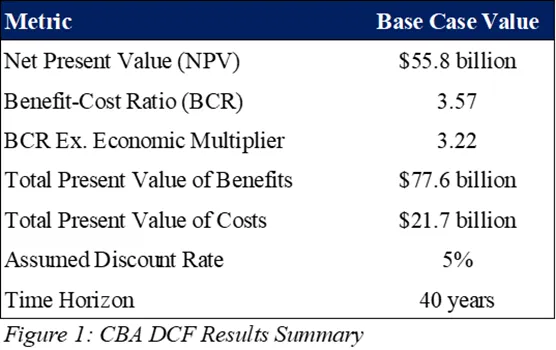
This cost-benefit analysis of the Nevada North Lithium Project (NNLP) demonstrates that the project is economically viable and delivers substantial net social benefits to the State of Nevada. Figure 1 (below) summarizes the results of our CBA. The base case yields an NPV of $55.8 billion and a benefit-cost ratio (BCR) of 3.57 (or 3.22 excluding the regional economic multiplier), indicating that the project's benefits are expected to significantly outweigh its costs. The total present value of benefits is estimated at $77.6 billion, while costs are $21.7 billion, demonstrating a compelling value proposition under standard evaluation criteria. The full model (discounted cash flow) and NPV is included in Appendix A, with annual cash flows for each individual cost and benefit monetized.
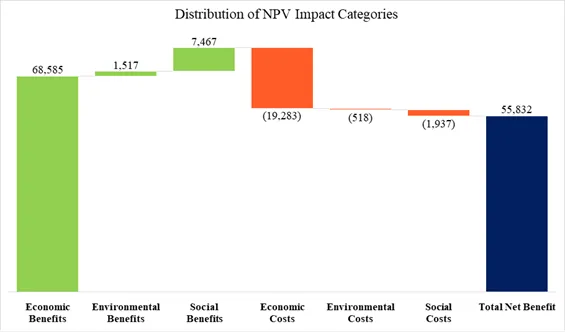
Economic benefits ($68.6 billion) are the most significant contributor, primarily driven by pre-tax profits (Surge Battery) and indirect employment impacts. Social benefits ($7.5 billion) reflect gains such as local business growth and broader economic participation. While environmental benefits are more modest ($1.5 billion), they include avoiding emissions by replacing imported lithium with a domestic supply.
The distribution of costs aligns somewhat with the benefits, with the most significant burden being economic costs ($19.3 billion), including CAPEX, OPEX, and infrastructure maintenance. Surge Battery will bear these costs. Environmental and social costs, although present, are relatively minor in scale ($0.5 billion and $1.9 billion, respectively) and primarily stem from impacts such as land degradation, water depletion, and health-related externalities. Appendix B includes a detailed breakdown of each benefit and cost component.
Limitations & Sources of Uncertainty
Despite this analysis's structured and conservative approach, several limitations and sources of uncertainty remain that could materially influence the cost-benefit outcomes. A primary uncertainty is the volatility of lithium prices, which directly affects projected revenues. While our model includes a baseline forecast and a plausible range of future prices, lithium markets remain highly sensitive to global demand shifts, policy incentives, and supply disruptions.
Economic and employment multipliers, taken from the Thacker Pass analysis in Humboldt County, present another source of uncertainty. These may not fully reflect the demographic and economic conditions specific to Elko County. While multipliers are more commonly used in economic impact studies than in CBAs, we deliberately included them in this model to ensure methodological consistency with the Thacker Pass precedent, likely to serve as a benchmark for NNLP. Their inclusion supports analytical rigor and enhances comparability, and we have accounted for this in our sensitivity analysis.
Additional uncertainty stems from using proxy-based valuations for environmental and social externalities, including cost per gallon of water treatment, the EPA’s Social Cost of Carbon (SCC), and asthma-related public health costs. While these proxies offer reasonable estimates, they may understate or overstate NNLP-specific effects given geographic, hydrological, and health factors that are not fully documented. Regulatory and geopolitical conditions also introduce risk, as future changes to environmental regulation, taxation, permitting, or international trade policy could materially alter the project’s costs and benefits over its lifecycle.
We applied a benefits transfer approach to estimate site-specific impacts without direct NNLP data to address these uncertainties. While this introduces potential margins of error, it provides a consistent and conservative basis for estimation. To further strengthen our analysis, we employed scenario testing and probabilistic modelling to evaluate the robustness of our findings under a range of plausible assumptions.
Risk and Sensitivity Analysis
To test the robustness of our findings, we conducted two forms of sensitivity analysis. First, we applied specific scenario testing focused on variations in the social discount rate and the profitability of mining operations—two key parameters that significantly influence the model. Second, we conducted a Monte Carlo simulation across 1,000 trials to assess the probability-weighted distribution of outcomes based on uncertainty in four key input variables: capital expenditures, operating costs, production output, and lithium price. Each of these is discussed in more detail below.
Discount Rate Sensitivity:
The base case analysis applies a real % discount rate of 5%, representing a midpoint between the social discount rate commonly used in public-sector evaluations (3%) and the private opportunity cost of capital (typically around 8%). To test the sensitivity of the project’s net present value (NPV) to this key assumption, we conducted a scenario analysis using these lower and higher discount rates:

This range helps evaluate whether the project remains net beneficial under both public and private capital assumptions, and whether long-term environmental and economic gains justify near-term investment.
5.2 Mine Profitability Sensitivity:
We conducted a targeted sensitivity analysis on project profitability, the most material driver of economic benefits in the NNLP cost-benefit model. Rather than adjusting individual assumptions, such as lithium price, production volumes, or operating costs, we applied a top-down percentage adjustment to EBIT (earnings before interest and tax). This approach reflects the cumulative impact of operational and market risks while avoiding double-counting or fragmenting the compounding effects embedded in profitability outcomes.
Revenues are a function of output and pricing, which drove the decision to adjust EBIT directly. At the same time, operating expenditures and depreciation costs are also embedded within profitability estimates. This method allows for a clearer sensitivity test of the mine’s core value generation potential while maintaining model consistency. Operating costs were held constant across scenarios to isolate the change in profitability and avoid overstating downside effects. Depreciation and associated tax effects were adjusted proportionally within the model to ensure consistency with the revised EBIT assumptions. As for the discount rate sensitivity, three scenarios were assessed:

This approach isolates the model's sensitivity to NNLP’s core revenue-generating potential while preserving modeling clarity and consistency across the cost-benefit framework.
5.3 Monte Carlo Simulation:
To evaluate the impact of uncertainty across key project variables on the Nevada North Lithium Project (NNLP) cost-benefit analysis, we conducted a Monte Carlo simulation with 1,000 iterations. This probabilistic modeling approach allows us to generate a distribution of potential project outcomes by varying core input assumptions simultaneously, providing a more comprehensive understanding of the project's risk-adjusted performance.
The variables selected —capital expenditures, operating costs, production output, and lithium prices —are among the most material and uncertain drivers of the project’s net benefits. Importantly, these are also commercial and operational variables for which a reasonable range and uncertainty distribution can be defined, based on market data, feasibility studies, and peer benchmarks. In contrast, factors such as regulatory shifts, public perception, or long-term ecological impacts were excluded from the simulation, as applying quantified uncertainty to these would involve an even higher level of speculation and could reduce rather than enhance model robustness. These four variables also affect key emissions-related externalities (i.e., mining emissions and avoided import emissions), which are modeled as functions of production volumes.
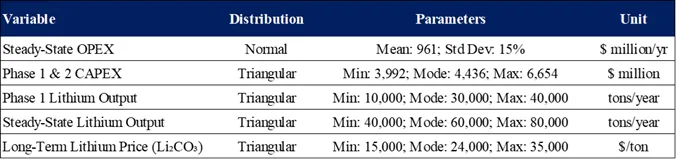
The table below summarizes the distributional assumptions and parameter values used in the simulation, followed by a detailed rationale for each input variable.
Steady-State Operating Costs:
We applied a normal distribution to model steady-state operating costs, using a mean of $961 million per year and a standard deviation of 15% (approximately $144 million per year). This reflects symmetric variation around the expected value, capturing uncertainty due to input prices, maintenance variability, and operational fluctuations. The mean is benchmarked against analogous projects, especially Thacker Pass, and the 15% deviation estimates cost volatility based on observed historical volatility across comparable lithium operations.
Phase 1 & 2 Capital Expenditures:
Phase 1 Lithium Output:
State-State Lithium Output:
Long-Term Lithium Price:
A triangular distribution was used to model capital expenditures during the project's initial development phases, capturing the asymmetric nature of uncertainty in early-stage mining investments. The mode ($4,436 million) is based directly on adjusted Thacker Pass figures, the most realistic NNLP comparators given similar geology, scale, and extraction methods.
The maximum value ($6,654 million) reflects a +50% overrun scenario, consistent with historical patterns observed in large-scale mining projects where permitting delays, contractor issues, or inflationary pressure on construction materials drive costs above base estimates. The minimum value ($3,992 million) reflects a -10% reduction relative to the mode, allowing for modest efficiency gains through procurement strategy or favorable input prices. However, this downward bound is relatively conservative, recognizing that significant capital savings in complex mining developments are uncommon. This range captures the most plausible variability in NNLP’s capital requirements without extending into unrealistic tail assumptions.
A triangular distribution was selected to reflect the uncertainty in lithium output during the ramp-up period. Based on academic and feasibility research from Thacker Pass, the maximum value (40,000 tons) reflects the estimated technical capacity at this stage. The mode (30,000 tons), used in the base case, represents 75% of maximum capacity – a conservative yet evidence-based assumption grounded in real-world mining ramp-up performance. The minimum (10,000 tons) reflects further downside of the same magnitude below the mode, representing potential delays or operational inefficiencies.
This variable follows a similar triangular structure. The maximum (80,000 tons) reflects peak operational potential. The mode (60,000 tons) is again set at 75% capacity, which aligns with industry norms and reflects the typical gap between nameplate and actual sustained output. The minimum (40,000 tons) mirrors the distance below the mode to capture downside scenarios (e.g. ore grade issues or mechanical limitations). This distribution ensures production uncertainty is incorporated without speculative tail assumptions.
A triangular distribution was applied to reflect the inherent volatility and asymmetrical risk in global lithium markets. The $24,000/ton mode value was selected based on triangulated pricing insights from industry forecasts (including Wood Mackenzie, Bernstein, and the US Geological Survey[18]), current market data (spot and futures), and long-term analyst expectations. This level reflects a conservative central estimate between the projected rebound after a 2025 supply surplus and stabilization in 2026–2027.
The minimum value of $15,000 per ton represents a plausible downside tied to temporary market oversupply, as highlighted in analyses by Goldman Sachs and Bernstein, where 2025 is widely forecasted as a potential market trough. Conversely, the maximum value of $35,000 per ton is intentionally bounded, despite historically higher prices in 2022 and early 2023, to avoid overestimating the potential upside. This cap reflects the expectation that future market rebalancing will stabilize prices below extreme historical highs through supply discipline and evolving EV demand. This approach anchors the simulation in current and forward-looking data while maintaining a prudent upper bound, reinforcing the overall conservatism of the net benefit estimates.
Simulation Execution and Outputs:
The Monte Carlo simulation was run with 1,000 iterations, where each trial generated a unique combination of variable values drawn from the specified distributions. Key project outcomes, including NPV and Benefit-Cost Ratio, were recalculated for each iteration. In addition to primary financial outcomes, externality-related outputs, such as mining emissions and avoided lithium import emissions, were adjusted dynamically based on the corresponding production volume in each trial. This approach ensures that the simulation reflects economic uncertainty and variability in environmental impact. The resulting distribution of outcomes enables a probability-weighted evaluation of the NNLP’s net social benefits, offering deeper insight into the project’s performance across various future states.
Sensitivity Analysis Results:
Across all scenarios tested, including variations in discount rates, project profitability, and probabilistic Monte Carlo simulations, the Nevada North Lithium Project (NNLP) delivers a positive Net Present Value (NPV) and a benefit-cost ratio (BCR) greater than 1.0, indicating that the project remains net beneficial under a wide range of assumptions.
Discount Rate Sensitivity:
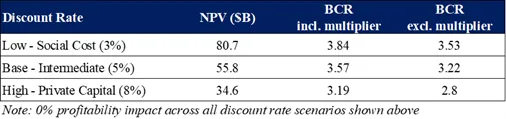
The project’s NPV is highly sensitive to the chosen discount rate, declining from $122 billion at 1% to approximately $30 billion at 9% and $26 billion at 10%. At our base case of 5%, the NPV is $55.8 billion, with a corresponding BCR of 3.57 (or 3.22 excluding the economic multiplier). Even at the upper-bound private capital rate of 8%, the project retains a robust NPV of $34.6 billion and a BCR of 2.09 (1.70 excluding multiplier). This indicates that even under stringent discounting assumptions, the project’s long-term benefits continue to outweigh its costs by a significant margin.
Mine Profitability Sensitivity:
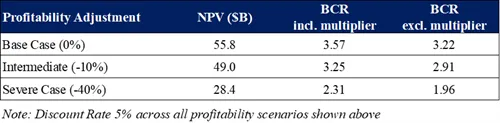
In our severe case scenario, where Surge Batteries’ project profitability is reduced by 40%, the NPV remains positive at $28.4 billion, with a BCR of 2.31 including multiplier, or 1.96 excluding multiplier. This reflects the compounding impact of adverse operational conditions (e.g., reduced recovery rates, price drops, or production shortfalls) but also demonstrates the project’s resilience, continuing to deliver state-level net benefits even under significantly constrained private outcomes.
Combined Worst Case Scenario:
In our combined worst-case scenario, where Surge Batteries’ project profitability is reduced by 40% and the highest (8%) discount rate is applied, the NPV remains positive at $17.3 billion, with a BCR of 2.09 including multiplier, or 1.70 excluding multiplier. This underscores the project's strong economic fundamentals and resilience, maintaining a compelling benefit-to-cost ratio and generating substantial public value even under highly conservative, downside-stacked assumptions.
Monte Carlo Simulation Results:
The Monte Carlo simulation, conducted over 1,000 iterations using probabilistic inputs for CAPEX, OPEX, lithium prices, and production output, produced an average Net Present Value (NPV) of $55.9 billion, closely aligned with the deterministic base case of $55.8 billion.
This strong alignment suggests that the central scenario is well-calibrated, neither excessively conservative nor optimistic. The range of outcomes extends from a minimum of $15.1 billion to a maximum of $107.1 billion, with a standard deviation of $15.5 billion, highlighting significant variability driven by key project uncertainties. The risk of a negative NPV is 0.00%, reinforcing confidence in the project's economic viability under various plausible conditions. Figure 3 below shows the distribution across NPV outcomes for our Monte Carlo Simulation.
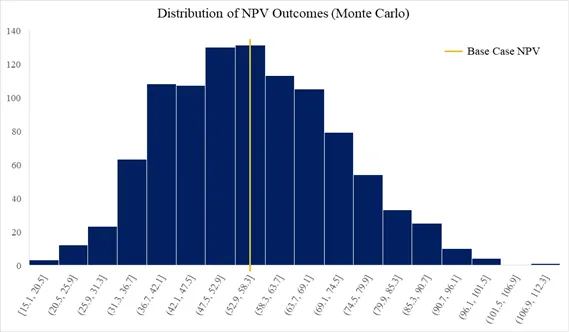
The distribution exhibits modest right skew (skewness = 0.26), suggesting that while most outcomes cluster near the mean, there is meaningful upside potential if market conditions, such as lithium prices or production efficiency, exceed expectations. The histogram confirms this, with the base case NPV positioned near the distribution’s peak, indicating that it remains a representative central outcome. The simulation reinforces the project's strong risk-return profile, showing limited downside exposure and considerable potential for value creation under favorable scenarios.
Sensitivity Analysis Results Summary:
Stress testing the model through sensitivity analysis reveals that the project’s value is robust even under conservative assumptions. When tested at the upper-bound discount rate of 8%, reflecting the opportunity cost of private capital, NNLP still delivers an NPV of $34.6 billion and a BCR above 2. In a severe downside scenario where Surge Batteries’ profitability is reduced by 40%, the project yields positive net benefits of $17.3 billion, with a BCR above 1.7.
The Monte Carlo simulation results further reinforce the economic case's strength. With an average NPV of $56.1 billion and a range from $17.4 billion to $113 billion, the simulation confirms that the base case is neither overly optimistic nor overly cautious. The risk of negative net benefits is 0%, and the model exhibits modest right skew, indicating some potential for upside beyond the central estimate.
Qualitative Considerations
While our model quantifies a wide range of economic, environmental, and social impacts, several significant considerations could not be monetized due to data limitations, lack of reliable valuation proxies, or insufficient site-specific information. Although excluded from the NPV/BCR calculations, these qualitative factors are vital to understanding the full scope of potential project impacts and responsibly guiding the final decision-making.
Unquantified Costs:
Biodiversity Loss and Ecosystem Impacts:
Although land disturbance and habitat restoration costs are monetized, the broader risk of biodiversity loss remains unquantified, particularly impacts to endemic or sensitive species.[19] The NNLP site lies within an ecologically constrained region, and complete biodiversity mapping has not been disclosed. Potential disruption to local flora and fauna, including cascading effects on ecosystem services, requires additional study and may justify precautionary conservation or offsetting measures.
Strain on Public Services and Infrastructure:
The anticipated influx of construction workers and long-term employees may pressure Elko County’s healthcare, education, emergency response, and transportation systems. This strain could translate into increased local government spending or reduced service quality for residents. However, these impacts are addressed only qualitatively due to the lack of granular projections on population inflow or fiscal offsets.
Road Safety Risks:
While infrastructure wear and repair costs were monetized, increased road traffic, particularly from heavy-duty mining trucks, poses a heightened risk of vehicle accidents. Empirical studies from similar mining operations show elevated collision and injury rates along haul routes,[20] yet precise data to model NNLP-specific outcomes were unavailable. These risks merit proactive traffic safety planning.
Indigenous and Cultural Heritage Considerations:
This consideration was initially included due to the Thacker Pass mine's notable negative impact on Indigenous communities, specifically regarding cultural heritage and land use. Federal and early environmental assessments of the NNLP confirm that the mine does not overlap with tribal lands or recognized sacred sites, nor is there an assessed potential risk of indirect negative impact on these communities. As such, this risk has been deemed not applicable following this analysis[21].
Unquantified Benefits:
Positive Knowledge Spillovers and Workforce Development:
Large-scale industrial projects like NNLP often generate spillover benefits through skills training, supplier development, and local workforce participation.[22] These dynamics may support long-term economic diversification in Elko County, particularly if linked with community college or apprenticeship partnerships. While economic multipliers partially capture induced effects, our quantitative model does not include the broader benefits of human capital accumulation.
Reputational Benefits for Nevada as a Sustainable Mining Hub:
Implementing NNLP with strong environmental and social safeguards could enhance Nevada’s reputation as a responsible critical mineral production leader. This reputational gain may improve the state’s ability to attract investment, secure federal funding, and influence national policy on domestic supply chains. Conversely, failure to manage ESG risks could damage the state’s credibility.
Summary of Qualitative Considerations
While the quantified impacts present a largely positive case for the continued operation of the NNLP, the qualitative considerations introduce critical aspects of social and environmental risk that would have otherwise been overlooked. Unpriced risks such as biodiversity loss, strain on public services, and increased road safety hazards indicate a need for strong institutional oversight and mitigation planning. Similarly, the benefits of potential knowledge spillovers and reputational gains emphasize the importance of implementation quality and regulatory credibility. Overall, the considerations identified highlight that the project's viability, desirability, and feasibility are not solely a function of economic return but contingent on robust risk management and widespread community buy-in.
Conclusion
Our findings support a clear conclusion: the NNLP represents a net gain for Nevada's economy, with benefits that remain resilient in the face of key market, operational, and financial uncertainties. The project not only strengthens domestic lithium supply security but does so with a substantial margin of economic safety, making it a compelling candidate for continued development, provided appropriate environmental and community safeguards are enforced. With that said, the following safeguards are recommended alongside continued mining operations:
- Implement a Water Resource Management Plan:
- Establish Biodiversity Offsetting and Conservation Measures:
- Enforce Robust Environmental Monitoring Commitments:
- Integrate Risk-Based Public Infrastructure Planning:
Given the project’s substantial groundwater demand in an arid region, a formal plan should be required to monitor and manage water withdrawals, prioritize conservation technologies, and minimize and mitigate potential conflict with other water users, particularly residents.
To address habitat disturbance, the project should commit to biodiversity offsetting, including restoration of ecologically comparable land and prompt protection of nearby habitats.
Regulatory agencies require continuous environmental performance reporting, including emissions, land disturbance, and reclamation progress. This should be strengthened through third-party verification to ensure transparency and accountability.
Increased demand for local services and traffic-related risks must be explicitly incorporated into planning frameworks. Coordinated investments, such as roads and emergency services, can help ensure public infrastructure remains resilient throughout the mine’s lifecycle.
The NNLP allows Nevada to advance its economic and energy transition goals through a strategically important resource. Realizing this potential responsibly will require regulatory oversight, community engagement, and a commitment to minimizing externalities. As federal incentives accelerate critical mineral production, NNLP can model how state-level planning aligns economic development with environmental stewardship.
Bibliography
- Borden, Buddy, and Thomas R. Harris. Estimated Economic and Fiscal Impacts from New Lithium Mining and Processing Operations in Humboldt County, Nevada (Publication No. SP 24-03). University of Nevada, Reno Extension, 2023. https://extension.unr.edu/publication.aspx?PubID=5291.
- Bureau of Land Management. NNLP Preliminary Environmental Assessment DOI-BLM-NV-E030-2025-0003-E. U.S. Department of the Interior, December 2023. https://eplanning.blm.gov/public_projects/2035156/200636015/20125326/251025306/20241219_NNL.
- EV Boosters. “U.S. Lithium Production and Market Trends in 2023.” EV Boosters, December 12, 2023. https://evboosters.com/ev-charging-news/u-s-lithium-production-and-market-trends-in-2023.
- Ghorbani, Yousef, Mohammad Ghorbani, Saeed M. Khezri, and Mohsen Yousefzadeh. “The Strategic Role of Lithium in the Green Energy Transition: Towards an OPEC-Style Framework for Green Energy-Mineral Exporting Countries (GEMEC).” Energy Policy 90 (2024). https://www.sciencedirect.com/science/article/pii/S0301420724001041.
- Kecojevic, Vladislav, Davor Komljenovic, and William Groves. “Investigation of Haul Truck-Related Fatal Accidents in Surface Mining Operations.” Safety Science 68 (2014): 138–145. https://doi.org/10.1016/j.ssci.2014.04.002.
- Kerr, Shane, Connor Bruce, and Martin Davis. Technical Report: Nevada North Lithium Project, Elko County, Nevada, USA. Surge Battery Metals, May 4, 2024. https://wp-surgebatterymetals-2024.s3.ca-central-1.amazonaws.com/media/2024/04/Surge-NNLP-NI-43-101-Report-04-05-2024.pdf.
- Lithium Americas Corp. Feasibility Study: National Instrument 43-101 Technical Report for the Thacker Pass Project, Humboldt County, Nevada, USA. 2023. https://s203.q4cdn.com/835901927/files/doc_financials/2023/ar/NewLAC-ThackerPassFea.
- Motley Fool Australia. “Here’s the Lithium Price Forecast through to 2028.” Motley Fool Australia, March 11, 2025. https://www.fool.com.au/2025/03/11/heres-the-lithium-price-forecast-through-to-2028/.
- Nasdaq. “Lithium Market: 2024 Year-End Review.” Nasdaq, December 20, 2024. https://www.nasdaq.com/articles/lithium-market-2024-year-end-review.
- Santos, Byron R., William L. Porter, and Alan G. Mayton. An Analysis of Injuries to Haul Truck Operators in the U.S. Mining Industry. National Institute for Occupational Safety and Health, 2014. https://stacks.cdc.gov/view/cdc/161026/cdc_161026_DS1.pdf.
- State of Illinois. Economic Impact of Asthma. Illinois Department of Central Management Services, n.d. https://cms.illinois.gov/benefits/stateemployee/bewell/financialwellness/economic-impact-of-asthma.html.
- Stephan, André, Ibrahim El-Darwish, and Robert H. Crawford. “Knowledge Spillovers from Lithium-Ion Battery Technology Innovation.” Energy Research & Social Science 48 (2019): 251–260. https://doi.org/10.1016/j.erss.2018.10.019.
- Surge Battery Metals. About Nevada North Lithium Project. 2025. https://surgebatterymetals.com/nevada-north-lithium-project/.
- U.S. Census Bureau. QuickFacts: Elko County, Nevada. 2023. https://www.census.gov/quickfacts/fact/table/elkocountynevada/PST045223.
- U.S. Department of Energy. Inflation Reduction Act of 2022. n.d. https://www.energy.gov/lpo/inflation-reduction-act-2022.
- U.S. Environmental Protection Agency. Greenhouse Gas Reporting Program Glossary: Short Ton Conversion. n.d. https://www.epa.gov/ghgreporting/greenhouse-gas-reporting-program-ghgrp-glossary.
- U.S. Environmental Protection Agency. Report on the Social Cost of Greenhouse Gases: Estimates Incorporating Recent Scientific Advances. 2023. https://www.epa.gov/system/files/documents/2023-12/epa_scghg_2023_report_final.pdf.
- U.S. Environmental Protection Agency. Treatment Technologies for Mining-Influenced Water. Office of Research and Development, 2014. https://nepis.epa.gov/Exe/ZyPDF.cgi/P100K2N4.PDF?Dockey=P100K2N4.PDF.
- Xu, Cheng, Wenbo Zhang, Ioanna Mouratiadou, and Han Hao. “Life Cycle Greenhouse Gas Emissions of Lithium-Ion Battery with Different Cathode Materials.” Applied Energy 262 (2020): 114553. https://doi.org/10.1016/j.apenergy.2020.114553.
About the Authors:
Annabel Gibson is pursuing a Master of Sustainability Management at Columbia University, where her work explores how financial and policy tools can drive sustainable outcomes. She brings nine years of experience in private markets, most recently structuring credit for European mid-market businesses at a UK bank. Outside of her academic and professional pursuits, she enjoys being outdoors, competes in various sporting events, and is an avid reader.
Melale Hailu is a recent graduate of Columbia University’s School of International and Public Affairs, where she earned a Master of Public Administration in Development Practice. She is an early-career development practitioner specializing in global health, food systems, and economic justice.