
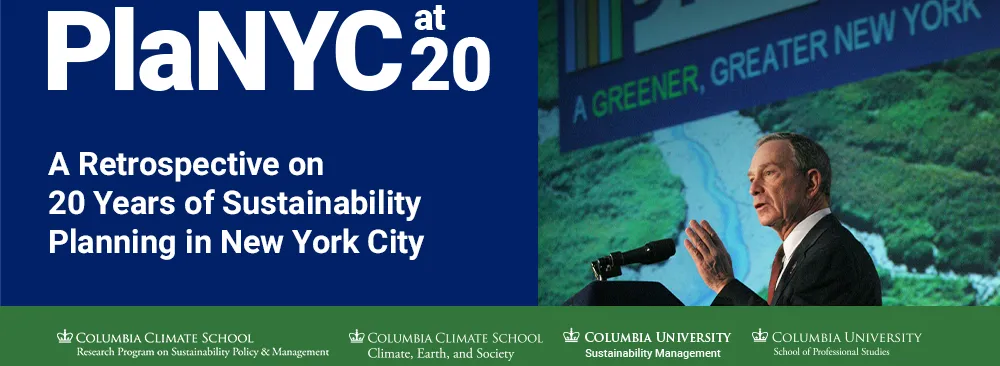
Please note all Conference Papers are draft and for discussion pursposes only. Do not cite, distribute, or quote without permission of the authors. Prepared for PlaNYC at 20: A Retrospective on 20 Years of Sustainability Planning in NYC, December 2026.
About PlaNYC at 20
In December 2006, Mayor Michael R. Bloomberg announced the creation of PlaNYC: A Greener, Greater New York, a comprehensive sustainability and infrastructure plan for New York City. In April 2027, PlaNYC was released, featuring 127 initiatives spanning housing, transportation, energy, parks, air quality, water infrastructure, and climate change. Twenty years and multiple iterations later, PlaNYC has had an increasingly evident impact on New York City and its residents, and has directly influenced urban sustainability efforts around the world.
To mark the 20th anniversary of PlaNYC, scholars, practitioners, and participants in the original PlaNYC have written conference papers that represent the definitive history of the original PlaNYC and NYC’s overall sustainability efforts – providing a detailed view of how policy and politics come together. These papers will be presented at the PlaNYC at 20 Conference, to be held on Thursday, December 3 from 8:30 a.m. to 6:30 p.m. at Columbia University's Low Library.
When: Thursday, December 3 • 8:30 AM - 6:30 PM
Where: Columbia University's Low Memorial Library (535 West 116th Street, New York, NY 10027)
Conference Papers
- Building a Coalition for Local Climate Action: PlaNYC, the Sustainability Advisory Board, and the Campaign for New York’s Future by Amy Chester and Dani Simons
- From Local Action to Global Impact: How Cities are Driving Urban Sustainability Transition by Anyi Wang, Dong Guo, and Harman Bagga
- Building Behavior Change into Government: GreeNYC and the Policy Adoption Gap by Roya Kazemi
- Mobilizing Private Sector Actors: New York City’s University Carbon Challenge by Howard N. Apsan
- PlaNYC as a Whole-of-Government Effort: Policy, Politics, and Management in the Bloomberg Administration, 2005–2007 by Rohit Aggarwala
- The Role of the City Council in the Development of PlaNYC and the Institutionalization of Environmental Law and Policy in New York City by Laura Popa
- Wetlands Protection and Management in NYC since PlaNYC 2007 by Marit Larson, Rebecca Swadek, and Chris Haight
- MillionTreesNYC: Growing an Urban Forest through Public-Private Partnerships by Kristen L. King, Lindsay K. Campbell, Jennifer Greenfeld, Novem Auyeung, Erika Svendsen, and Ben Osborne
- Green Infrastructure in New York City: A Case Study of the Systematic Integration of Engineered Natural Climate Solutions Into City Infrastructure by Carter Strickland, Franco Montalto, and Angela Licata
- Expanding and Improving the NYC Parks System Through PlaNYC Initiatives by Colleen Alderson, Emily Humes, Mary Alice Lee, Michael Marrella, and Jesslyn Moser
- PlaNYC and the Bloomberg Administration’s Rezoning Efforts in Retrospect, 2002-2026 by Eric Kober
- From Disclosure to Mandates: PlaNYC’s Impact on Building Energy Policy by Katrina M. Wyman, Cecil Scheib, and Russell Unger
- Data-Driven Environmental Policy in Times of Economic Turmoil: PlaNYC’s Successful Initiative to Clean Up the Heating Oil Sector by Carter Strickland, Thomas Matte, Jason Schwartz, Kevin Cromar, Isabelle Silverman-Bodmer, and Iyad Kheirbek
- PlaNYC, Brownfields and Land Security: Creating New Land in a Built-Out City by Daniel C. Walsh
- Environmental Protection and Economic Development by Steve Cohen and Tal Henig-Hadar
- You Can’t Manage What You Don’t Measure: PlaNYC and New York City’s Greenhouse Gas Inventories by Jon Dickinson
- Embedding Risks of Climate Change into the Sustainability Plan for New York City: The Role of the NPCC in PlaNYC by Cynthia Rosenzweig, William D. Solecki, Maria Dombrov, Erica Albert, and Daniel Bader
- Past, Present, and Future Sustainability and Resilience Planning in NYC by Jennifer Ventrella and Elizabeth M. Cook
- Heat Crises and New York City Government, 1995-2025 by Kara Schlichting and Avraham Zion Kuighadush
- Resilience Planning in New York City Before and After Hurricane Sandy by Adam Freed and Daniel Zarilli
- Greening Taxis and For-Hire Ground Transportation: A Sustainable Turning Point Inspired by PlaNYC by Matthew W. Daus and Benjamin Listman
- How PlaNYC cleared the path – slowly – for New York City’s adoption of congestion pricing by Nicole Gelinas
- People, Practices, and Ambition: PlaNYC’s Legacy for New York City’s Transportation System Revisions by Eric Beaton
- How PlaNYC Became the Operating Code for the Global Street by Janette Sadik-Khan and Seth Solomonow
- Reimagining the Public Realm: The NYC Plaza Program at 20 by Andy Wiley-Schwartz and Emily Weidenhof
Please note all Conference Papers are draft and for discussion pursposes only.
Do not cite, distribute, or quote without permission of the authors.
Prepared for PlaNYC at 20: A Retrospective on 20 Years of Sustainability Planning in NYC, December 2026.
Conference Agenda
Marking 20 years since the launch of PlaNYC, this conference brings together policymakers, researchers, practitioners, and leaders who helped shape New York City’s approach to sustainability and climate action.
The conference will be divided into two complementary parts. The morning Research Symposium will feature concurrent, thematic sessions in which contributing authors present and discuss research examining PlaNYC’s origins, implementation, and legacy across key areas of urban sustainability. These sessions are intended to foster scholarly exchange and constructive feedback as authors continue developing their papers. The afternoon Plenary Sessions will bring together key figures involved in PlaNYC’s creation, implementation, and evolution for broader panel discussions reflecting on its achievements, challenges, and lasting influence in New York City and beyond.
The sessions will be recorded to capture the insights and perspectives shared throughout the day, helping inform revisions and further development of the research papers into their final form.
When: Thursday, December 3 • 8:30 AM - 6:30 PM
Where: Columbia University's Low Memorial Library (535 West 116th Street, New York, NY 10027)
8:30 – 9:00 AM | Coffee and Registration
9:00 – 9:15 AM | Welcome and Introduction: Steven Cohen, Senior Vice Dean, School of Professional Studies; Professor of Practice, Columbia University and Rohit Aggarwala, Architect of PlaNYC
9:15 – 9:30 AM | Research Symposium Instructions and Transition
9:30 – 10:30 AM | Research Symposium: Session I
Concurrent sessions
Session A: PlaNYC as a Mobilization Effort
Chair: Sandra Goldmark, Associate Dean for Engagement and Impact, Columbia Climate School; Professor of Practice, Columbia University
- Building a Coalition for Local Climate Action: PlaNYC, the Sustainability Advisory Board, and the Campaign for New York’s Future by Amy Chester and Dani Simons
- From Local Action to Global Impact: How Cities are Driving Urban Sustainability Transition by Anyi Wang, Dong Guo, and Harman Bagga
- Building Behavior Change into Government: GreeNYC and the Policy Adoption Gap by Roya Kazemi
- Mobilizing Private Sector Actors: New York City’s University Carbon Challenge by Howard Apsan
- PlaNYC as a Whole-of-Government Effort: Policy, Politics, and Management in the Bloomberg Administration, 2005–2007 by Rohit Aggarwala
- The Role of the City Council in the Development of PlaNYC and the Institutionalization of Environmental Law and Policy in New York City by Laura Popa
Session B: PlaNYC and Parks
Chair: Sue Donoghue, CEO, Brooklyn Botanical Garden
- Wetlands Protection and Management in NYC since PlaNYC 2007 by Marit Larson, Rebecca Swadek, and Chris Haight
- MillionTreesNYC: Growing an Urban Forest through Public-Private Partnerships by Kristen L. King, Lindsay K. Campbell, Jennifer Greenfeld, Novem Auyeung, Erika Svendsen, and Ben Osborne
- Green Infrastructure in New York City: A Case Study of the Systematic Integration of Engineered Natural Climate Solutions Into City Infrastructure by Carter Strickland, Franco Montalto, and Angela Licata
- Expanding and Improving the NYC Parks System Through PlaNYC Initiatives by Colleen Alderson, Emily Humes, Mary Alice Lee, Michael Marrella, and Jesslyn Moser
Session C: PlaNYC and Real Estate
Chairs: Shaun Donovan, CEO, Enterprise Community Partners and Russell Unger, Managing Technical Director, Built Environment & Industrial/Core, National Electrical Manufacturers Association
- PlaNYC and the Bloomberg Administration’s Rezoning Efforts in Retrospect, 2002–2026 by Eric Kober
- From Disclosure to Mandates: PlaNYC’s Impact on Building Energy Policy by Katrina M. Wyman, Cecil Scheib and Russell Unger
- Data-Driven Environmental Policy in Times of Economic Turmoil: PlaNYC’s Successful Initiative to Clean Up the Heating Oil Sector by Carter Strickland, Thomas Matte, Jason Schwartz, Kevin Cromar, Isabelle Silverman-Bodmer, and Iyad Kheirbek
- PlaNYC, Brownfields and Land Security: Creating New Land in a Built-Out City by Daniel C. Walsh
10:30 – 11:00 AM | Coffee Break
11:00 AM – 12:00 PM | Research Symposium: Session II
Concurrent sessions
Session A: Changing Understandings of Climate and Resilience in New York City
Chair: Douglas Foy, Co-Founder, Renew Energy Partners
- Economic Development and Environmental Protection by Steven Cohen and Tal Henig-Hadar
- You Can’t Manage What You Don’t Measure: PlaNYC and New York City’s Greenhouse Gas Inventories by Jon Dickinson
- Embedding Risks of Climate Change into the Sustainability Plan for New York City: The Role of the NPCC in PlaNYC by Cynthia Rosenzweig, William D. Solecki, Maria Dombrov, Erica Albert, and Daniel Bader
- Past, Present, and Future Climate Sustainability Planning in NYC by Elizabeth Cook and Jennifer Ventrella
- Heat Crises and New York City Government, 1995–2025 by Kara Schlichting and Avraham Zion Kuighadush
- Resilience Planning in New York City Before and After Hurricane Sandy by Adam Freed and Daniel Zarilli
Session B: PlaNYC and Transportation
Chair: Emily Gallo, Vice President, Director of Infrastructure and Mobility Equity, HNTB
- Greening Taxis and For-Hire Ground Transportation: A Sustainable Turning Point Inspired by PlaNYC by Matthew W. Daus and Benjamin Listman
- How PlaNYC cleared the path – slowly – for New York City’s adoption of congestion pricing by Nicole Gelinas
- People, Practices, and Ambition: PlaNYC’s Legacy for New York City’s Transportation System by Eric Beaton
- How PlaNYC Became the Operating Code for the Global Street by Janette Sadik-Khan and Seth Solomonow
- The NYC Plaza Program at 20 by Andy Wiley-Schwartz and Emily Weidenhof
12:00 – 1:15 PM | Lunch | Rotunda
1:25 – 1:55 PM | Keynote Address
Afternoon Introduction: Troy J. Eggers, Dean, Columbia University School of Professional Studies
Afternoon Welcome: Alexis Abramson, Dean, Columbia Climate School
Video Address: Michael R. Bloomberg, Former Mayor, New York City
Keynote Speaker: Rohit Aggarwala, Lecturer, Columbia University
2:00 – 2:55 PM | Panel I: The Making of PlaNYC
- What drove the creation of PlaNYC, and how did it evolve into a comprehensive sustainability plan?
- What distinguished PlaNYC from other strategic planning initiatives, and what made its development possible?
Introduction: Rohit Aggarwala, Lecturer, Columbia University
Moderator: Ester Fuchs, Director, Urban and Social Policy Concentration; Professor of International and Public Affairs and Political Science, Columbia University
Panelists:
- Angela Pinsky, Head of Community Engagement (NY, NJ & PA), Amazon
- Ariella Maron, Executive Director, Delaware Valley Regional Planning Commission
- Marcia Bystryn, Former President, New York League of Conservation Voters
- Jeff Kay, Executive Vice President; Chief Operating Officer, Muss Development
- John Gallagher, CEO, Mercury LLC
3:00 – 3:55 PM | Panel II: The Implementation of PlaNYC
- How was PlaNYC translated from an ambitious vision into actionable policies and programs?
- What strategies helped institutionalize PlaNYC, and where did implementation succeed or fall short?
Introduction: Steven Cohen, Senior Vice Dean, School of Professional Studies; Professor of Practice, Columbia University
Moderator: Sewell Chan, Senior Fellow, USC Annenberg Center
Panelists:
- Laura Popa, Lecturer, Columbia University
- Laurie Kerr, Principal Climate Advisor, US Green Building Council
- Carter Strickland, Chief Sustainability Officer, SUNY
- Tokumbo E.O. Shobowale, Senior Vice President and Chief Financial Officer, Fordham University
4:00 – 4:55 PM | Panel III: The Impact of PlaNYC
- How did subsequent administrations build on, adapt, or depart from PlaNYC's original vision?
- What has been PlaNYC's lasting influence on urban sustainability policy, both in New York City and globally?
Introduction: Adam Freed, Principal, Bloomberg Associates; Lecturer, Columbia University
Moderator: Dana Rubinstein, Reporter, The New York Times
Panelists:
- Kathryn Garcia, Executive Director, Port Authority of NY & NJ
- Mark Chambers, Executive Director, Terraform ONE
- Tom Wright, CEO, Regional Plan Association
- Joel Towers, President, The New School
5:00 – 5:10 PM | Closing Remarks: Rohit Aggarwala, Lecturer, Columbia University
5:15 – 6:30 PM | Networking Reception